Prospecting
Outbound account prioritisation
Separate account eligibility from priority, choose an outbound queue the team can work and revise it as evidence changes.
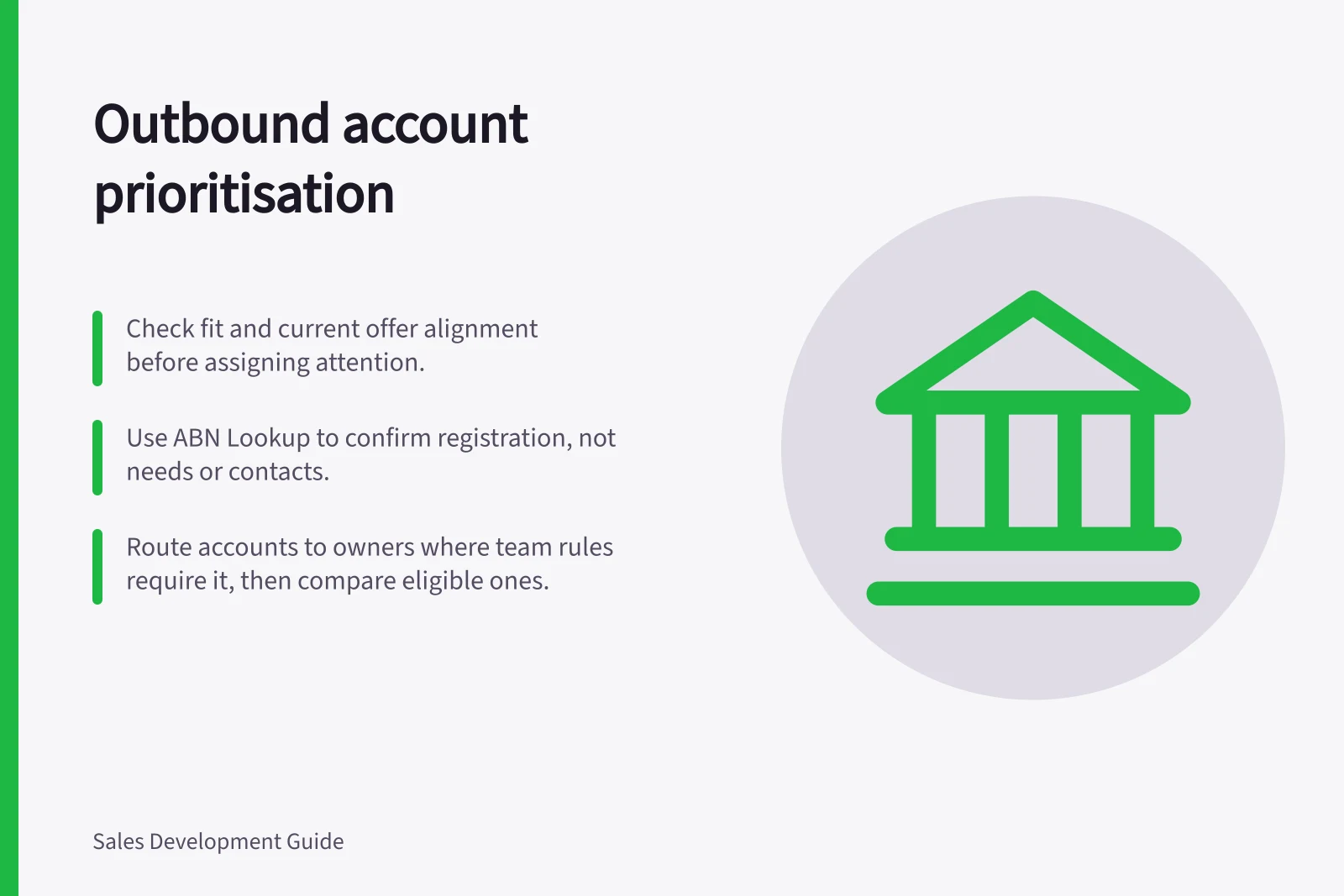
Prioritise outbound accounts by deciding which eligible organisations deserve the team's limited attention now. Check whether the current offer can serve the account and whether another owner is already working it.
Then compare fit, a checked reason to investigate now and the work the team can complete. Priority does not establish buying intent or permission to contact a person.
Key Compliance and Data Sources for Australian B2B Teams
- ABN Lookup
- Confirm entity registration details via ABN Lookup
- CRS & FATCA Reporting
- Self-review toolkit for tax compliance obligations
- Spam Prevention
- ACMA guidelines to avoid sending spam in outbound communications
- Pillar Two Tax Readiness
- PwC guide for 30 June 2026 filers
Keep eligibility and queue position separate
A confirmed service mismatch excludes an account for the current offer. If a decisive requirement is unknown, hold it for a focused check. Route an existing customer or active opportunity to its owner where the team's ownership rules require it. Only then compare eligible accounts for the active queue.
| State | Decision | Next action |
|---|---|---|
| Exclude | A confirmed requirement rules out the current offer. | Record the requirement, source and date. |
| Hold | A decisive fact is missing. | Assign a check before active outreach. |
| Route | Another owner has the relationship or conversation. | Pass on the observation. |
| Eligible | Known facts support further investigation. | Compare priority with other eligible accounts. |
These are workflow states, not predictions. ABN Lookup can confirm an entity's public registration details, but not its needs, contacts or industry code.
Order eligible accounts
Assess fit against the offer's current requirements. Separately assess timely relevance: is there a dated, traceable development that gives the team a useful question to investigate now?
A strong fit may have no current reason for attention. A recent announcement may be relevant while a necessary offer condition remains unverified.
A stated plan to add a site does not prove the site opened, that an existing process is failing or that a purchase is planned. Treat an opaque third-party intent label as a prompt to inspect its underlying evidence, not as the account's own statement.
Where eligible candidates are similarly compelling, consider which material question the team can resolve and who owns the next action. Record the reason for moving an account ahead so the order can be revised when facts change.
Match the active queue to available work
Include only accounts the team can investigate, route and review while still handling responses. Estimate that capacity from the team's available time and its own approach. Give each active account a next decision, an owner and a review point. Keep other eligible accounts in reserve until capacity or relevant facts change.
Identify business responsibilities only when they matter to the proposed conversation. A title does not establish a named person's actual authority, preferences or willingness to hear from the team.
Revisit the reason for priority
At the review point, compare the original selection reason with what the team learned. Correct stale facts and distinguish silence from an explicit decline. An account with no useful response may need a role check, a premise check or a delivery investigation; silence alone identifies none of these causes.
Record the new evidence and decision, then update the account's state and queue position. The queue remains a revisable work plan rather than a permanent ranking of companies.
In this guide
- Ranking accounts by fit and timely relevanceCompare offer fit with a dated reason to investigate now, without turning a signal into a buying-intent claim.
- Identifying a buying committee without guessing personal traitsMap the decisions involved in a potential purchase, check responsibilities and avoid unsupported claims about named people.
- Choosing a manageable first outbound account listSize an initial account list from the work and response capacity available, then keep eligible overflow in reserve.
- Reviewing accounts that repeatedly receive no useful responseReview account fit, ownership, premise and contact outcomes before spending more time on an unresponsive outbound account.