Prospecting
Part of Outbound account prioritisation
Reviewing accounts that repeatedly receive no useful response
Review account fit, ownership, premise and contact outcomes before spending more time on an unresponsive outbound account.
When an account repeatedly yields no useful response, review the account decision before assigning it more time.
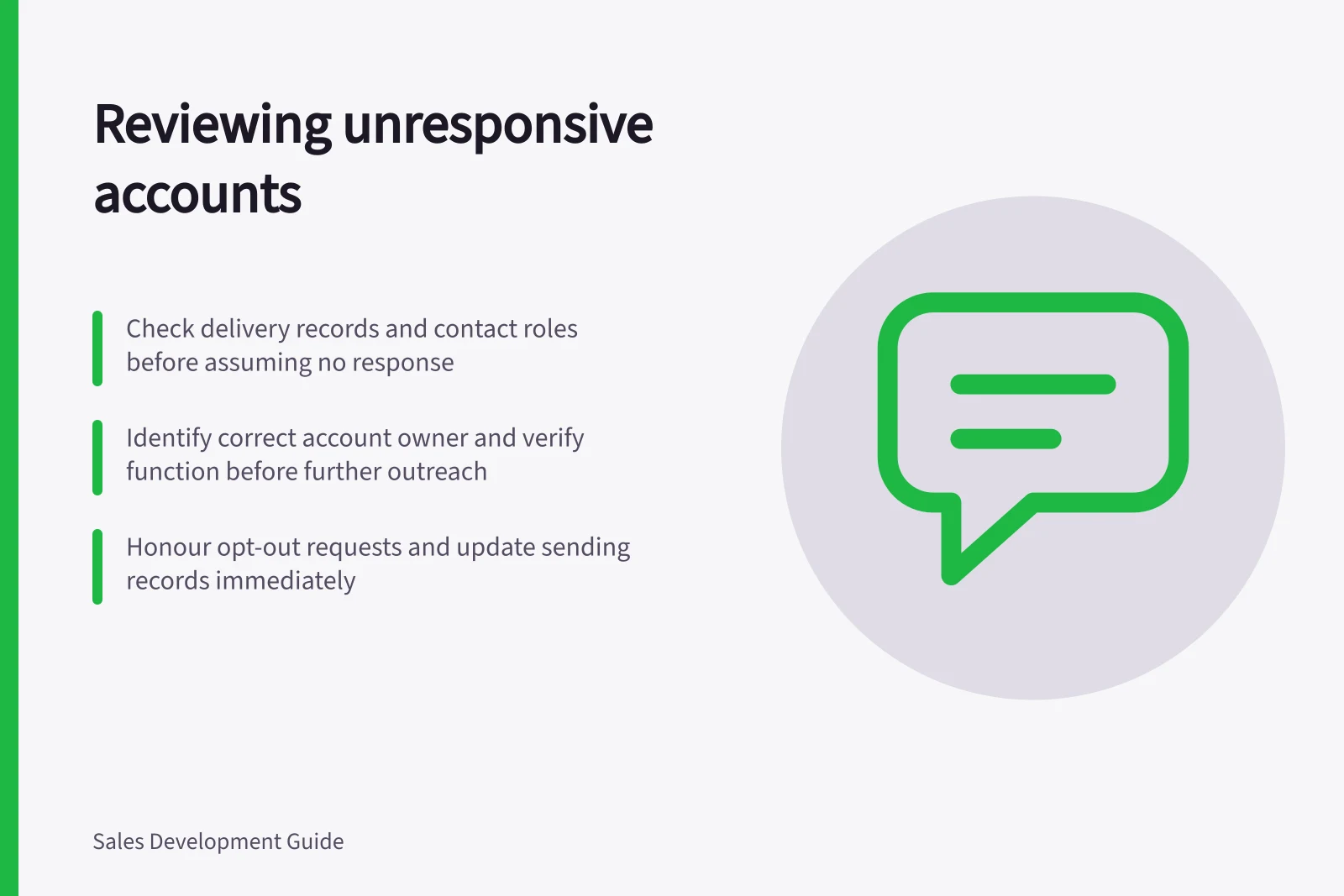
Check what was attempted, what the sending record establishes, whether the relevant business responsibility was identified and whether the original reason for priority still holds. Silence alone does not reveal the cause or prove poor fit.
Reconstruct the account record
Bring together the dated account premise, ownership history, contact roles and outcomes. Keep no reply separate from an automatic response, delivery failure, referral, explicit decline and opt-out. Do not call a message “ignored” when a tool only records that it was sent.
Look across the account before judging it. Different representatives may have approached different people, or an existing owner may already have received an answer. Reconcile duplicate records and current conversations so an account is not labelled unresponsive from one incomplete view.
Check the plausible causes
| Finding | Question | Account decision to consider |
|---|---|---|
| Sending route or outcome is unclear | What do the available delivery records establish? | Hold further outreach on the affected route for investigation. |
| Responsibility was inferred from a title | Did the contacted person own the relevant work? | Check the function before another approach. |
| Original premise has weakened | Is the dated observation still true and relevant? | Return the account to reserve or close that premise. |
| Fit is unknown or disproved | Can the current offer meet the material requirement? | Check an unknown or exclude a confirmed mismatch. |
| A person declined or opted out | What did the person ask the business to stop? | Honour the request and update the relevant sending records. |
These are questions, not diagnoses. A sending-system status does not prove a person saw a message. Several unanswered attempts do not prove that the account has no need.
Account Review Checklist Before Re-engaging
- Verify delivery records and sending route status
- Confirm the contacted person’s actual responsibility for the decision
- Reassess if the original business premise is still valid
- Validate account fit with current offering
- Check for opt-out requests or decline notifications
Choose the next account action
Further work needs a fresh reason: a material error was corrected, an appropriate account owner identified a relevant function or a current development raises a different question. Repeating the same premise with another contact does not by itself justify keeping the account active.
Record one decision: continue with a stated new question; hold for a named check; return an eligible account to reserve; route it to its owner; or exclude it after a confirmed mismatch. Preserve the earlier reason and the evidence that changed it. This makes reconsideration possible without turning temporary silence into a permanent judgement.
A review cannot override a person's stop request. For Australian commercial electronic messages, refer to ACMA's 'Avoid sending spam' guidance.
Remove queued marketing steps promptly so another send does not occur while systems are updated. Revisiting an account later must not reactivate a person who opted out.