SDR Operations
Part of Measuring sales development performance
Booked meetings versus held qualified meetings
Define booked, held and qualified meetings, handle reschedules and no-shows, and calculate comparable rates from one booking cohort.
A booked meeting is an agreement to meet. A held qualified meeting records two later findings: the discussion took place and it met the team's relevance rule. Report these separately so cancellations, no-shows and attended but unsuitable discussions do not appear as the same result.
Booked, held and qualified meetings compared
- Booked meeting
- An agreement to meet; does not prove attendance, relevance or qualification
- Held meeting
- The discussion took place; it may still be unqualified
- Held qualified meeting
- The discussion took place and met the team's relevance rule
- Attended but unsuitable
- May be useful for follow-up without becoming a qualified sales meeting
Give each intended discussion a traceable outcome
Start with the original booking. Keep its date and a stable reporting ID, even if rescheduling creates another calendar event or meeting record. Link the records so one intended discussion does not become two bookings. Record the scheduled date, purpose, relevant attendees, latest outcome and when it was confirmed.
Use clear states such as scheduled, rescheduled with a future date, cancelled, no-show, held and outcome unknown. Agree whose absence makes a meeting a no-show. If the salesperson missed it while the prospect attended, do not label the prospect a no-show. A cancellation before the meeting is not a held discussion.
A calendar event alone does not establish attendance. Confirm the outcome from the meeting owner or a reliable meeting record. Some CRMs offer a Completed outcome, but the team still needs to decide what evidence supports marking it completed. That outcome does not establish qualification.
From original booking to qualified meeting outcome
- Original bookingKeep its date and a stable reporting ID; link reschedules so one intended discussion does not become two bookings
- ScheduledRecord scheduled date, purpose, relevant attendees and confirmation time
- OutcomeHeld, cancelled or no-show; confirm from the meeting owner or a reliable meeting record
- Qualification decisionQualified, unqualified or pending review, with a brief reason
- ReportingReport held share and qualified share separately, and show future rescheduled meetings and unknown outcomes alongside the fraction
Track each intended discussion
- Stable reporting IDKeep with the original booking
- Scheduled date and purposeRecord for the intended discussion
- Relevant attendeesList who needed to attend
- Latest outcomeScheduled, rescheduled with a future date, cancelled, no-show, held or outcome unknown
- Confirmation timeRecord when the outcome was confirmed
- Linked reschedulesPrevent one intended discussion becoming two bookings
Decide qualification separately
Agree on the rule before reporting it. A local rule might require a relevant issue or question expressed by the prospect, plausible fit with the current offer and a purpose for further sales discussion. Record a known disqualifying requirement. Leave material unknowns open if a focused follow-up could resolve them.
Mark each held meeting qualified, unqualified or pending review, with a brief reason. An attended discussion that leads to a justified close can be useful without becoming a qualified sales meeting. Attendance by someone seeking general information does not automatically meet the rule.
Follow one booking cohort
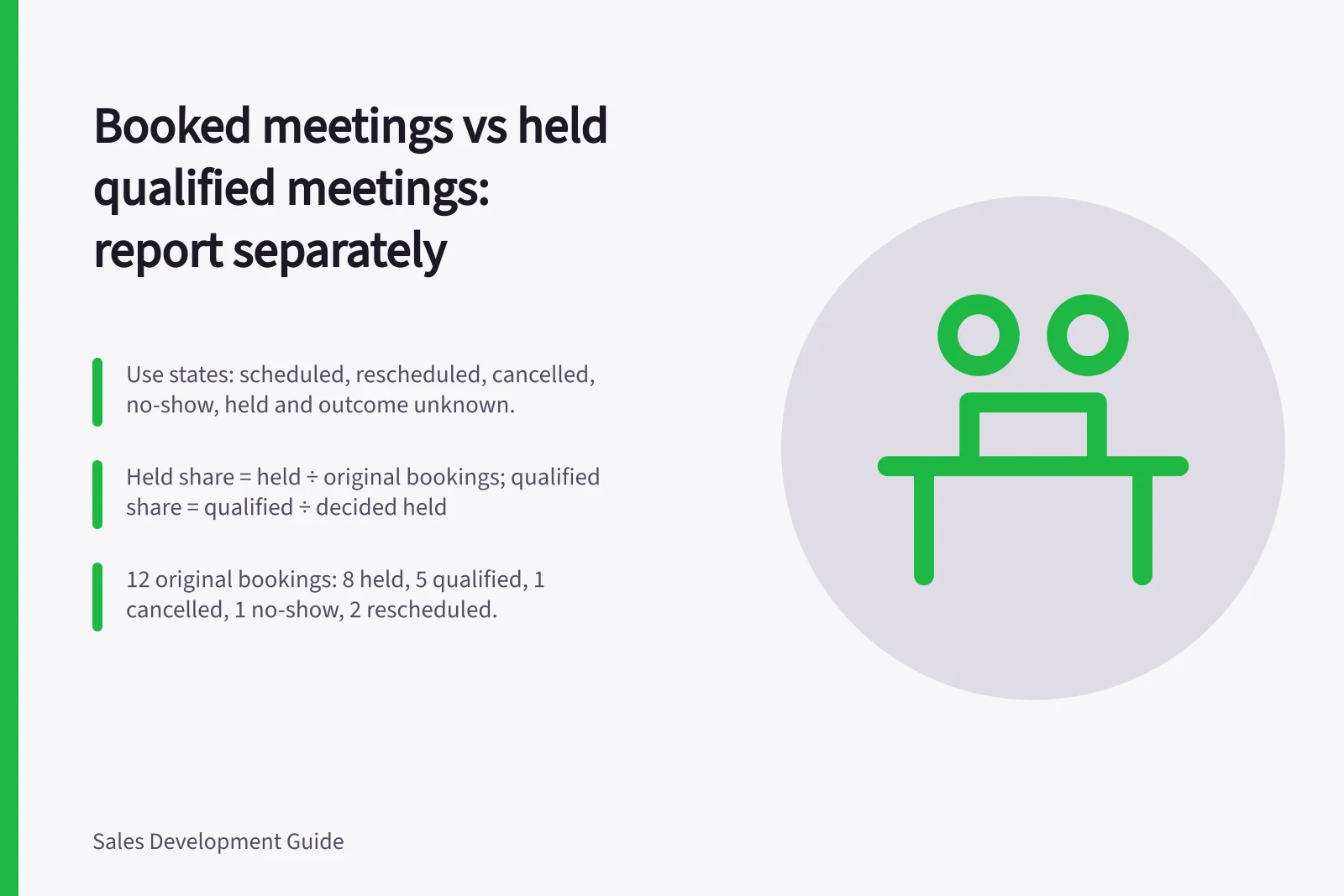
For meetings first booked in a chosen period, follow each to a stated cut-off. Held share = held meetings ÷ original bookings. Show future rescheduled meetings and unknown outcomes alongside the fraction; it is provisional while they remain open.
For held meetings, qualified share of decided held meetings = held meetings marked qualified ÷ held meetings with a qualification decision. Show pending qualification decisions separately.
In a fictional cohort of 12 original bookings, eight have been held, one cancelled, one ended in a no-show and two have future rescheduled dates at the cut-off. Five of the eight held discussions qualified, and all eight have a qualification decision.
The report shows eight held out of 12 bookings and five qualified out of eight decided, held meetings. The first fraction may change when the rescheduled meetings occur. These are arithmetic examples, not benchmarks.
Compare booking cohorts after giving them a comparable period to mature. Bookings made late this month and meetings held early this month may concern different prospects.
Review cancellation and no-show reasons if held share changes; review the booking premise and recorded qualification reasons if attendance holds but qualification changes. Keep disputes about a meeting's qualification decision separate from the later decision to accept an SDR handoff.