Deliverability
Part of Measuring sales development performance
Measuring opportunity acceptance after an SDR handoff
Define sales-owner acceptance, track returned and pending SDR handoffs, and calculate a rate without equating CRM records with decisions.
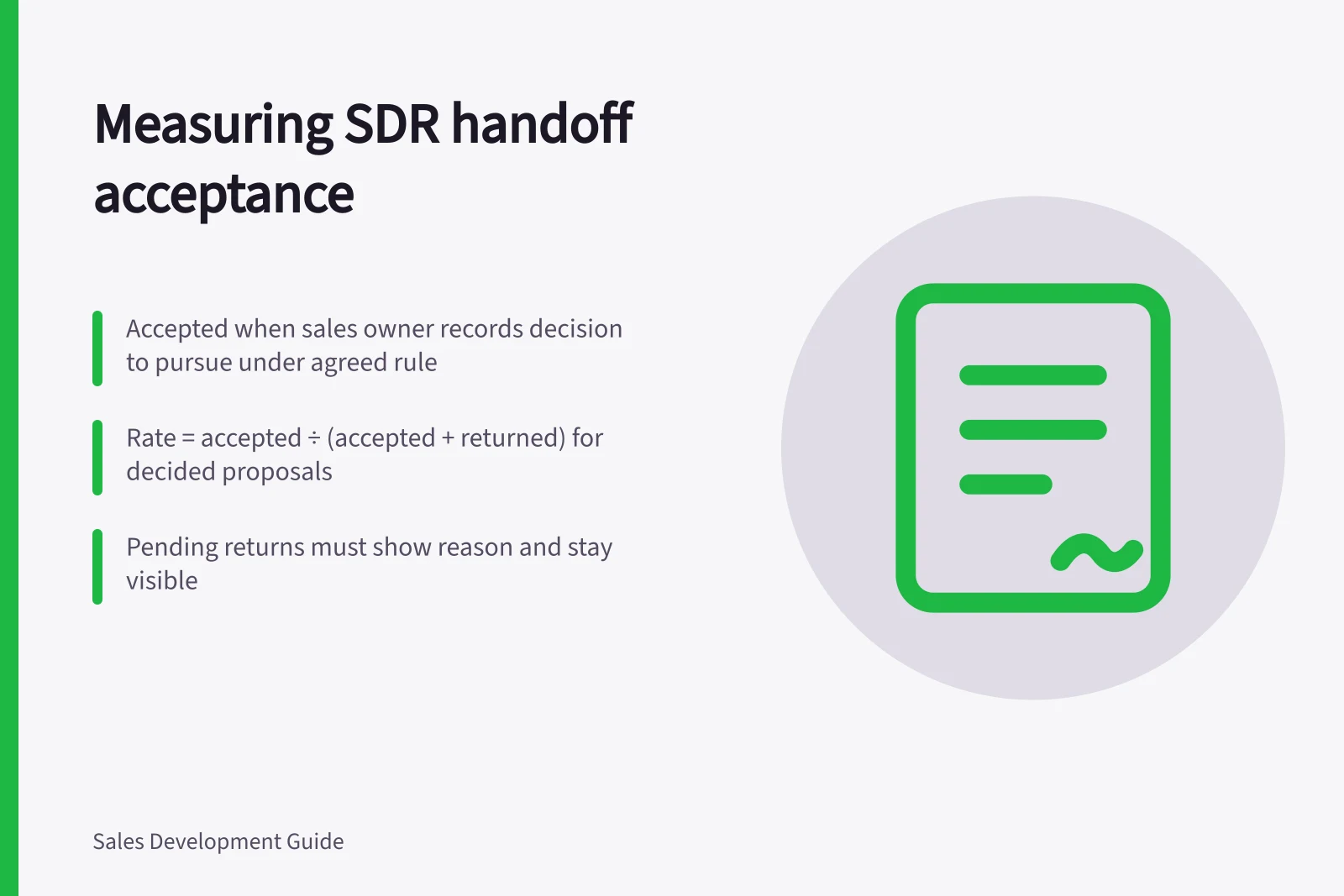
For this measure, count an opportunity as accepted when the receiving sales owner records a decision to pursue the SDR's proposed handoff under an agreed rule. A booked meeting, an SDR's qualified label or the creation of an opportunity record does not, by itself, record that decision. Keep returns and decisions still pending visible.
Define the decision and its unit
Agree who can accept or return a handoff and when the decision is due. Record the submission time, decision time, owner, status and reason for a return. Useful states are submitted or pending, accepted, returned and withdrawn.
Set the unit as one proposed opportunity or handoff, then give it an ID that survives corrections. A corrected resubmission should remain linked to the original proposal; it should not silently become a second accepted opportunity.
The receiving owner needs a consistent threshold. They might accept when the prospect has described a relevant issue, the current offer is plausibly suitable, the next sales action has a purpose and known constraints are visible. Acceptance need not mean that budget, buying date or final technical fit has been established. State which unknowns can remain open and which must be checked first.
In Dynamics 365 Sales, qualifying a lead may create an opportunity automatically or involve a seller's creation decision, depending on configuration. That product event is distinct from this team's receiving-owner decision. If a business uses record creation as its acceptance event, it must check that its configuration and workflow make the two events equivalent before reporting them as one.
Using CRM Record Creation as Acceptance Indicator
- ProsSimplifies tracking; automated in Dynamics 365 Sales when configured.
- ConsMay not reflect actual sales owner decision; risk of misalignment if not properly configured.
Keep returns informative
Record reasons that suggest different responses: confirmed offer mismatch, no prospect-stated reason to continue, missing context, duplicate or wrong owner, or a change in the prospect's plans. A return does not automatically mean poor SDR work.
Preserve the reason given at the time, even if a corrected handoff is later accepted. Repeated disagreements may indicate that the acceptance rule needs clarification.
Calculate the rate from submitted handoffs
Choose proposals first submitted in a defined period and follow them to a stated cut-off. Assign each proposal its latest decision by that date, while retaining its decision history. Accepted share of decided proposals = accepted proposals ÷ (accepted proposals + returned proposals). Show pending and withdrawn proposals separately.
Also show accepted proposals as a share of all submitted proposals if a backlog may be affecting the decided-only rate. Neither denominator should count a corrected resubmission as a new proposal.
In a fictional cohort of 14 proposals, ten are accepted, two returned and two pending. The decided-proposal share is ten out of 12. The all-submissions view is ten out of 14, with two decisions outstanding. Neither fraction is a win rate or evidence that the opportunities will become customers.
Check decision time alongside the rate. Before comparing periods or representatives, look for changes in the rule, sales capacity, account mix, duplicates and late decisions.
If returns repeatedly cite missing context, identify the information needed for a decision. If they cite confirmed offer mismatch, review the earlier fit rule. This measure ends at the receiving owner's decision; later opportunity progress is a separate question.