
SDR Operations
Measuring sales development performance
Build a sales development scorecard that separates activity, useful conversations, held qualified meetings and accepted handoffs.
Measure sales development by the decisions its work enables: useful conversations, meetings that take place and meet an agreed qualification rule, and handoffs accepted by a sales owner.
Keep activity and bookings visible, but they do not prove that a prospect received a useful next step. Some conversations rightly end with an answer, referral or decision to stop; the stages below are not a mandatory path for every account.
Build a small scorecard
| Measure | Record | Question |
|---|---|---|
| Activity | Contact actions taken, by channel and account segment | How much work was done with the intended group? |
| Useful conversation | A two-way exchange that resolved a relevant question | What did the team learn or decide? |
| Meeting booked | An agreement to meet for a stated purpose | What next step was proposed? |
| Meeting held and qualified | Attendance confirmed and the local qualification rule met | Did the discussion warrant further sales work? |
| Handoff accepted | The receiving owner recorded a decision to pursue it | Did the proposed handoff meet the agreed threshold? |
These are reporting definitions to agree locally, not universal CRM labels. Document each rule, who records the outcome and when. A completed activity does not establish that an exchange was useful; an opportunity record does not, by itself, establish that its receiving owner accepted a handoff.
Key Sales Development Performance Metrics
- Activity
- Contact actions taken, by channel and account segment
- Useful Conversation
- A two-way exchange that resolved a relevant question
- Meeting Booked
- An agreement to meet for a stated purpose
- Meeting Held and Qualified
- Attendance confirmed and local qualification rule met
- Handoff Accepted
- Receiving owner recorded a decision to pursue
Compare like with like
Choose a cohort and cut-off date before calculating rates. For outbound work, one option is to group accounts by the date of their first attempt, then follow later conversations and handoffs. Keep outcomes still pending at the cut-off visible. Comparing new attempts this month with accepted handoffs this month mixes work at different ages.
Show each numerator and denominator. Useful conversations divided by attempts answers a different question from the share of contacted accounts that had at least one useful conversation: an account can receive several attempts and have more than one exchange.
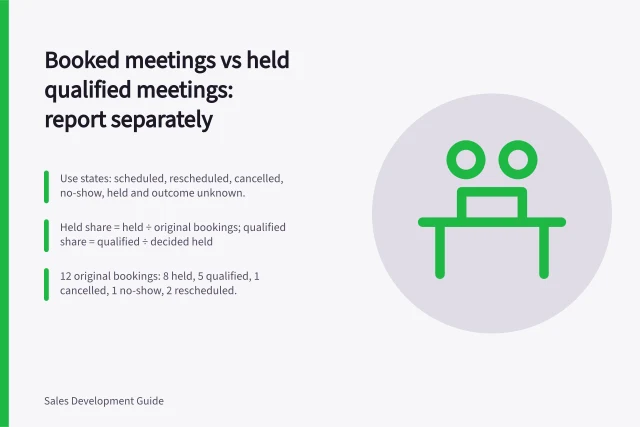
For meetings, report the share of original bookings that were held separately from the share of assessed, held meetings that qualified. Do not present either as an unexplained conversion rate.
Link rescheduled meetings and duplicate records before counting. State whether each measure counts accounts, contacts, conversations, meetings or handoffs; these totals cannot simply be added together. Break out material differences such as inbound and outbound work or account segment when the mix changes.
Performance Comparison: Original Bookings vs. Qualified Held Meetings
- Share of Original Bookings That Were Held
- Report separately from qualified meetings
- Share of Held Meetings That Qualified
- Based on agreed local qualification rule
Investigate gaps before changing targets
- Many attempts, few useful conversations:
- check account eligibility, contact roles, responses and missing outcome notes.
- Many bookings, fewer held meetings:
- check cancellations, no-shows and reschedules.
- Held meetings, few qualified meetings:
- compare what prospects said with the agreed qualification rule.
- Qualified meetings, few accepted handoffs:
- review the receiving owners’ decisions and reasons for returns.
Inspect underlying records before attributing a gap to a representative or a process. An empty outcome field may mean the result was not recorded. A pending acceptance is not a rejection. Record when a definition changes so later cohorts are not compared as though the rule stayed the same.
A weekly review can show counts and cut-off dates for attempts, distinct accounts contacted, useful conversations, original bookings, held meetings, qualification decisions, submitted handoffs, acceptances, returns and pending outcomes. Keep declines and stop requests visible too.
Compare representatives only where assignments, channels, recording rules and observation periods make the comparison meaningful. End with a specific question to check, its owner and the records needed to answer it.
Weekly Review Checklist for Sales Development Performance
- Count of attemptsTrack by representative and cohort
- Distinct accounts contactedEnsure no duplicates or rescheduled records are double-counted
- Useful conversationsVerify outcome notes are complete and recorded
- Original bookings and held meetingsLink rescheduled and duplicate records before counting
- Qualification decisions and handoff acceptancesReview reasons for returns and pending outcomes
Interpret CRM statuses in context
A lead marked qualified does not necessarily mean an opportunity record was created or that the sales process advanced. In Microsoft Dynamics 365, the configured qualification experience affects what happens next; where no opportunity is created, the lead can have a Qualified status without the business process moving to its next stage.
Keep disqualified outcomes distinct from missing or pending outcomes. Microsoft Dynamics 365 supports disqualifying leads that do not meet the team’s criteria while maintaining an audit trail, so a closed-out lead need not disappear from performance review.
Pros and Cons of Using CRM Statuses as Performance Indicators
- Pros
- Provides audit trail; supports tracking disqualification decisions in Microsoft Dynamics 365
- Cons
- Qualified lead status does not guarantee opportunity creation or process advancement
In this guide
- Booked meetings versus held qualified meetingsDefine booked, held and qualified meetings, handle reschedules and no-shows, and calculate comparable rates from one booking cohort.
- Measuring opportunity acceptance after an SDR handoffDefine sales-owner acceptance, track returned and pending SDR handoffs, and calculate a rate without equating CRM records with decisions.
- Comparing activity volume with useful conversationsSeparate contact attempts, connections and useful conversations, then compare activity with outcomes using consistent cohorts and denominators.