Ideal Customer Profiles
Part of Sales development for B2B teams
Sales development versus account management
See how sales development and account management differ, where they overlap and how to assign ownership of existing-customer opportunities.
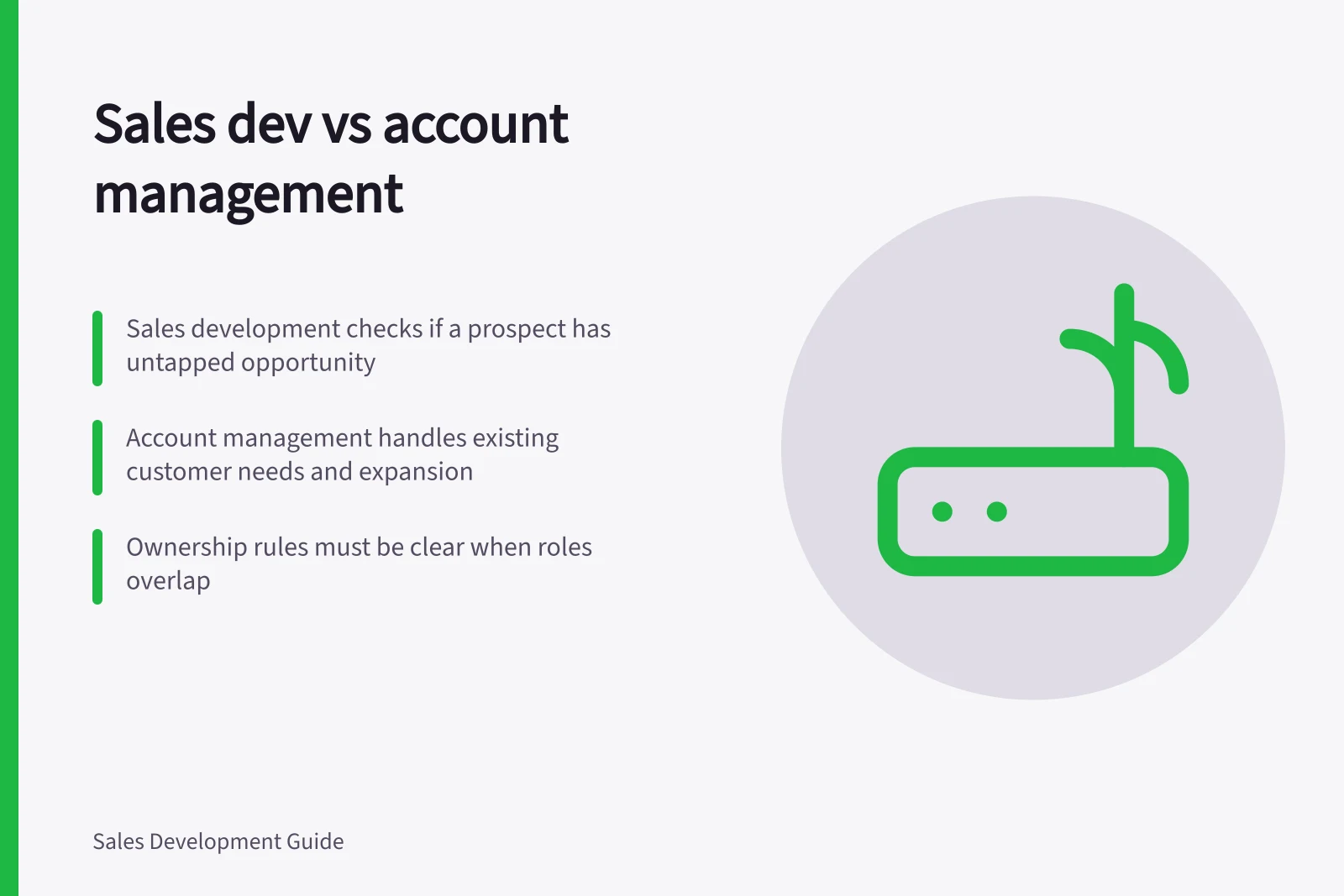
Sales development usually starts or assesses potential sales conversations. Account management usually looks after an existing customer relationship, including current needs, issues and possible expansion. The distinction is the relationship and decision each role owns, not whether someone sends an email or books a meeting.
| Decision | Sales development | Account management |
|---|---|---|
| Main question | Is there a relevant opportunity to explore? | What does this customer need from the existing relationship? |
| Typical starting point | A prospective contact or early enquiry | An established customer account |
| Useful next step | An informed handoff, a focused check or a clear stop | An agreed customer action, service coordination or a relevant expansion discussion |
| Record to protect | What the prospect said and what remains unverified | Relationship history, commitments and current priorities |
These are working distinctions. A business may assign expansion prospecting to sales development, or give an account manager responsibility for new contacts within an existing customer. Set that boundary explicitly.
Sales Development vs Account Management: Key Differences
- Main question
- Is there a relevant opportunity to explore?
- Typical starting point
- A prospective contact or early enquiry
- Useful next step
- An informed handoff, a focused check or a clear stop
- Record to protect
- What the prospect said and what remains unverified
- Main question
- What does this customer need from the existing relationship?
- Typical starting point
- An established customer account
- Useful next step
- An agreed customer action, service coordination or a relevant expansion discussion
- Record to protect
- Relationship history, commitments and current priorities
A new person at an existing customer
A new contact is not necessarily a new account. Before approaching them, check whether an account manager, customer success colleague or sales owner is already discussing the issue. The current owner can advise whether another contact would help, duplicate work or conflict with a commitment to the customer.
Suppose a software supplier learns that a customer has opened a second office. A sales development representative might see a prospecting signal. The account manager may already know that the customer is focused on its first deployment.
Share the observation with the account owner and agree whether anyone should raise it. The announcement alone does not prove a need for more software.
Handling a New Contact at an Existing Customer
- Verify existing ownershipCheck if an account manager, customer success team member or sales owner is already engaged with the customer.
- Assess relevanceDetermine whether the new contact (e.g. new office) indicates a genuine opportunity for expansion or support.
- Share observationInform the account owner of the new contact and context (e.g., second office opened).
- Agree on actionConfirm whether a follow-up is appropriate—do not assume consent to send marketing emails.
Decide ownership where roles overlap
Write a rule for recurring cases such as a new department, subsidiary, expansion enquiry, former customer or inbound request from an existing account. Identify who may make first contact, who must be informed and who owns the resulting conversation. Check any stop request. Existing-customer status alone does not establish consent to send a marketing email.
A transfer record can be brief: why the contact arose, what the person requested, relevant account context, any known stop preference and the next agreed action. Label a proposed action as a proposal until it is agreed. The account owner can then accept, redirect or decline the referral without treating an unverified signal as a customer commitment.
Ownership Rules for Overlapping Roles
- Define ownership for recurring scenariosInclude new departments, subsidiaries, expansion enquiries, former customers and inbound requests from existing accounts.
- Identify who makes first contactEnsure clarity on initial outreach responsibility.
- Specify who must be informedEnsure transparency across teams.
- Clarify who owns the conversationAvoid duplication and conflict in customer engagement.
- Respect stop preferencesExisting-customer status does not imply consent to receive marketing communications.
Judge each role by its contribution
Sales development can review whether the conversations it starts are relevant and accepted by the next owner. Account management may review whether customer commitments and requests are handled. Both can uncover commercial opportunities, but their responsibilities should remain clear to the customer and to colleagues.
Key Metrics for Role Accountability
- Sales development success rate
- Percentage of conversations initiated that are accepted by account management
- Account management response time
- Average time to act on customer commitments or requests