Ideal Customer Profiles
Part of Sales development qualification
Distinguishing curiosity from a genuine business problem
Use recent examples, consequences and priority to distinguish an exploratory enquiry from a business problem worth discussing.
A prospect’s curiosity is a reason to answer their question. A business problem becomes clearer when they can describe what they are trying to change, what happens today and why the difference matters. Do not treat a brochure request or an enthusiastic reaction as proof that a project exists.
Ask what prompted the interest
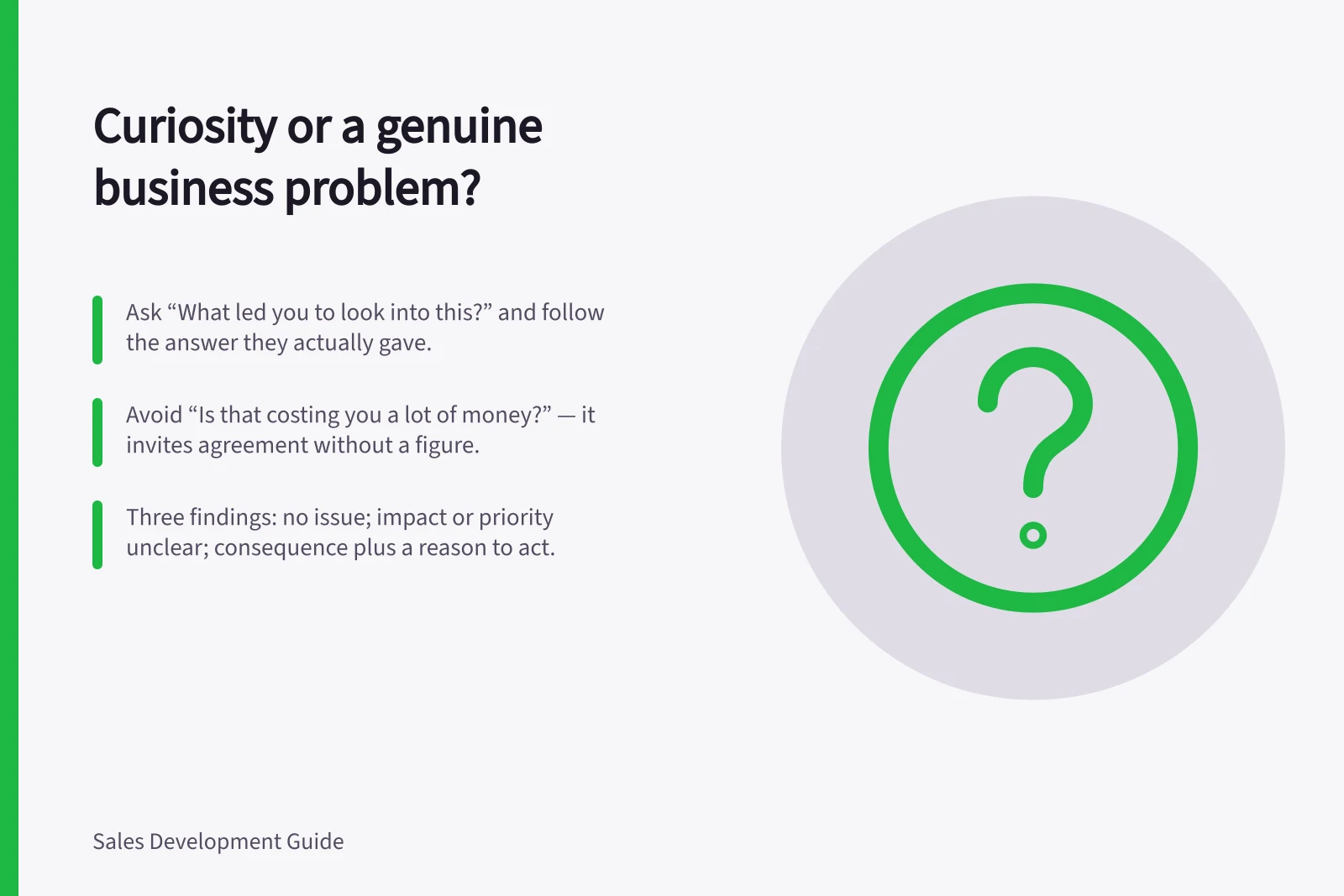
Begin with a neutral question: “What led you to look into this?” The answer may be a specific difficulty, a planned change, an internal request or simple market research. Follow the answer that was actually given.
If the prospect mentions a difficulty, ask for a recent example: what work was underway, where did it become difficult and who dealt with the result? Then ask what they have done so far and what would improve if the issue were resolved. Avoid supplying the consequence for them: “Is that costing you a lot of money?” invites agreement without establishing a figure.
Look for a reason to act
A problem can be real without being a current priority. Ask how the prospect weighs it against other work and whether anyone owns the decision to explore a change.
Their answer may identify a near-term review, a later project or no plan at all. A missing budget on an introductory call does not by itself settle whether the underlying problem is genuine. Use three distinct findings:
| What you know | Suitable next action |
|---|---|
| The prospect wants general information and has named no issue to investigate | Answer the question briefly and leave further contact to their preference. |
| They describe an issue, but its impact or priority is unclear | Ask one focused follow-up or offer information that helps them assess it. |
| They describe a relevant issue, its consequence and a reason to examine it | Check whether your offer could help, then propose a specific next discussion if they want one. |
These are conversation outcomes, not labels for the person.
From general interest to a problem worth acting on
- They want general information and have named no issue to investigateAnswer the question briefly and leave further contact to their preference
- They describe an issue, but its impact or priority is unclearAsk one focused follow-up, or offer information that helps them assess it
- They describe a relevant issue, its consequence and a reason to examine itCheck whether your offer could help, then propose a specific next discussion if they want one
Keep the response useful either way
Consider a hypothetical enquiry about automating monthly reporting. “We are seeing what tools exist” signals curiosity.
“Our team has to rebuild the same report after each system change, and the operations lead is reviewing that process” gives a concrete issue and an owner. It still leaves open whether your offer works with their systems and whether a project will proceed.
Summarise what you heard and invite correction before deciding. If the interest is exploratory, share the requested explanation without manufacturing urgency. If a problem is emerging, identify the one fact that would make a follow-up useful.
Curiosity versus a genuine business problem
- “We are seeing what tools exist”Curiosity: no issue and no owner named. Share the requested explanation without manufacturing urgency
- “Our team has to rebuild the same report after each system change, and the operations lead is reviewing that process”Genuine problem: a concrete issue and a named owner. Still open whether your offer works with their systems and whether a project will proceed