SDR Coaching
Part of SDR coaching
Reviewing a sales conversation against its objective
Review an SDR conversation against its original purpose, inspect turning points and choose one coaching action.
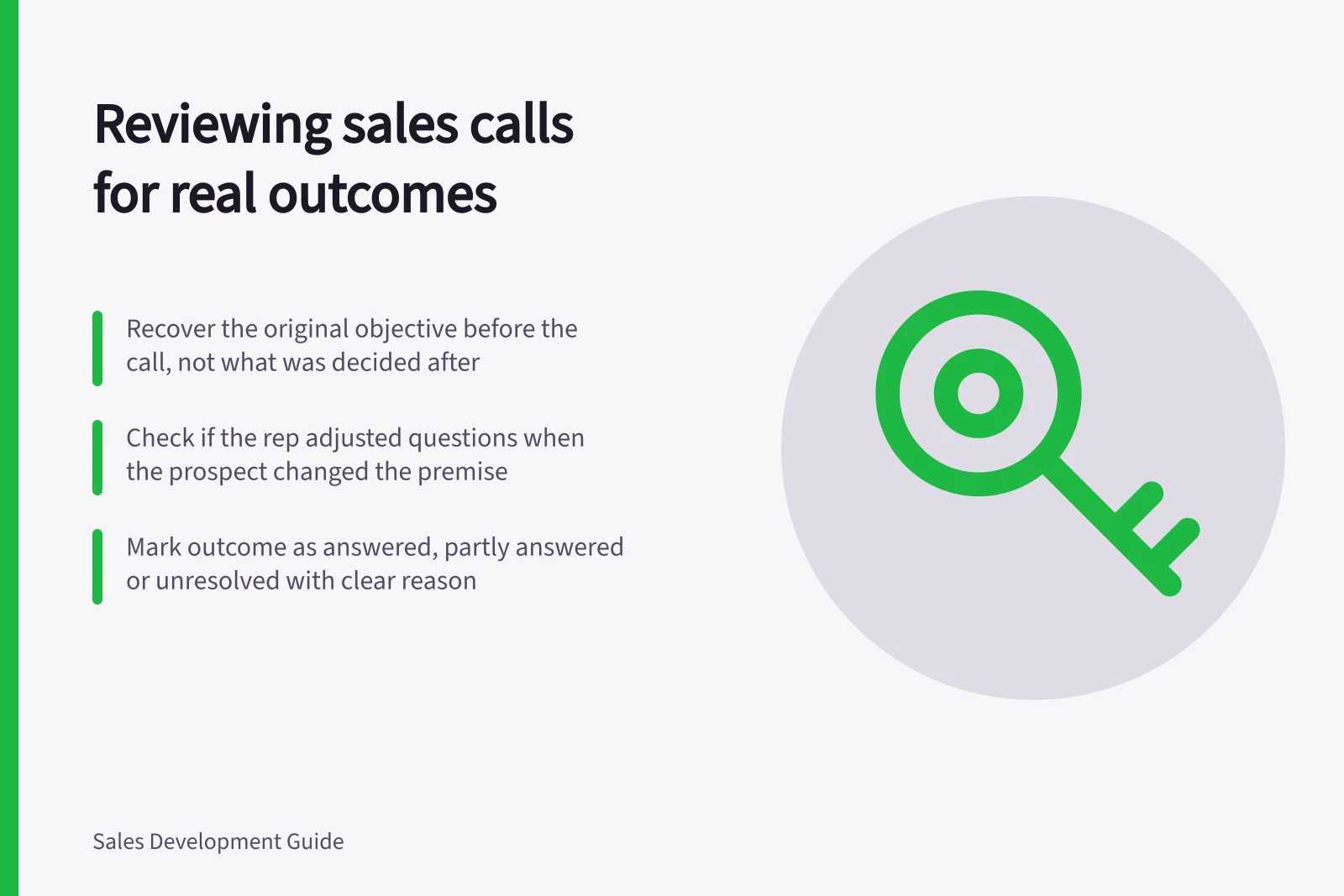
Review a completed sales conversation by asking whether it resolved the question the call was meant to address and led to an appropriate next decision. Recover the objective as it stood before the call, inspect the exchange that mattered, and judge the result from what the prospect actually said. Do not substitute “book a meeting” for the original objective after the call.
Recover the intended decision
Look for the objective in a preparation note or opening agreement. It might have been to learn whether a prospect's process creates a relevant issue, whether a required system is available, or whether a specialist check would help.
If no objective was recorded, ask what the representative understood it to be and label that answer retrospective. The review can still be useful, but it cannot establish that the account was the original plan.
Express the objective as a question that could have been answered yes, no or not yet. Keep prior account facts separate from the prospect's answer. A public announcement might explain why a topic was raised; it would not establish a problem.
Inspect the turning points
Read the note or review an approved recording in sequence. Find where the prospect confirmed, corrected or rejected the premise. Then examine what the representative did with that answer:
- Did the representative give the prospect room to explain their approach?
- When an answer changed the premise, did the next question change too?
- Was a material constraint checked before the offer was presented as suitable?
- Did the closing action address what remained uncertain?
Record the relevant exchange in a brief, accurate paraphrase. Call length or talk time cannot show whether the representative understood an answer. If only a sparse CRM note is available, mark the finding limited rather than filling gaps with guesses.
Judge the result, including a stop
A simple review can mark the objective answered, partly answered with a named next check, or unresolved. Record the reason.
The objective may be answered when a prospect says their process is already working or confirms a requirement the offer cannot meet. A respectful close can then be the right decision.
In a fictional example, a representative aims to find out whether a team needs help routing service requests. The prospect explains that a recent change has resolved the issue.
If the representative checks that answer and closes the topic, the call may have met its objective. Booking a demonstration would not improve that finding simply because it fills a calendar.
Common Outcomes After Reviewing a Sales Conversation
- Objective Answered
- Prospect confirms process works or requirement is unmet
- Partly Answered – Next Check Needed
- Uncertainty remains; requires further validation or research
- Unresolved
- No clear answer; no next step agreed
Choose one coaching action
Ask which choice the representative would repeat and which they would change. Select one moment to practise.
After “we already have a process”, an alternative might be a neutral check of whether any part remains difficult, followed by acceptance if the answer is no. Agree on a later conversation to review.
This review concerns the call's original purpose. Account qualification, handoff acceptance and booking targets require their own decisions and evidence.