Deliverability
Part of SDR-to-sales handoffs
Passing the prospect's own words rather than inflated claims
Keep prospect statements, estimates, SDR inferences and open questions distinct so the next salesperson starts from an accurate account.
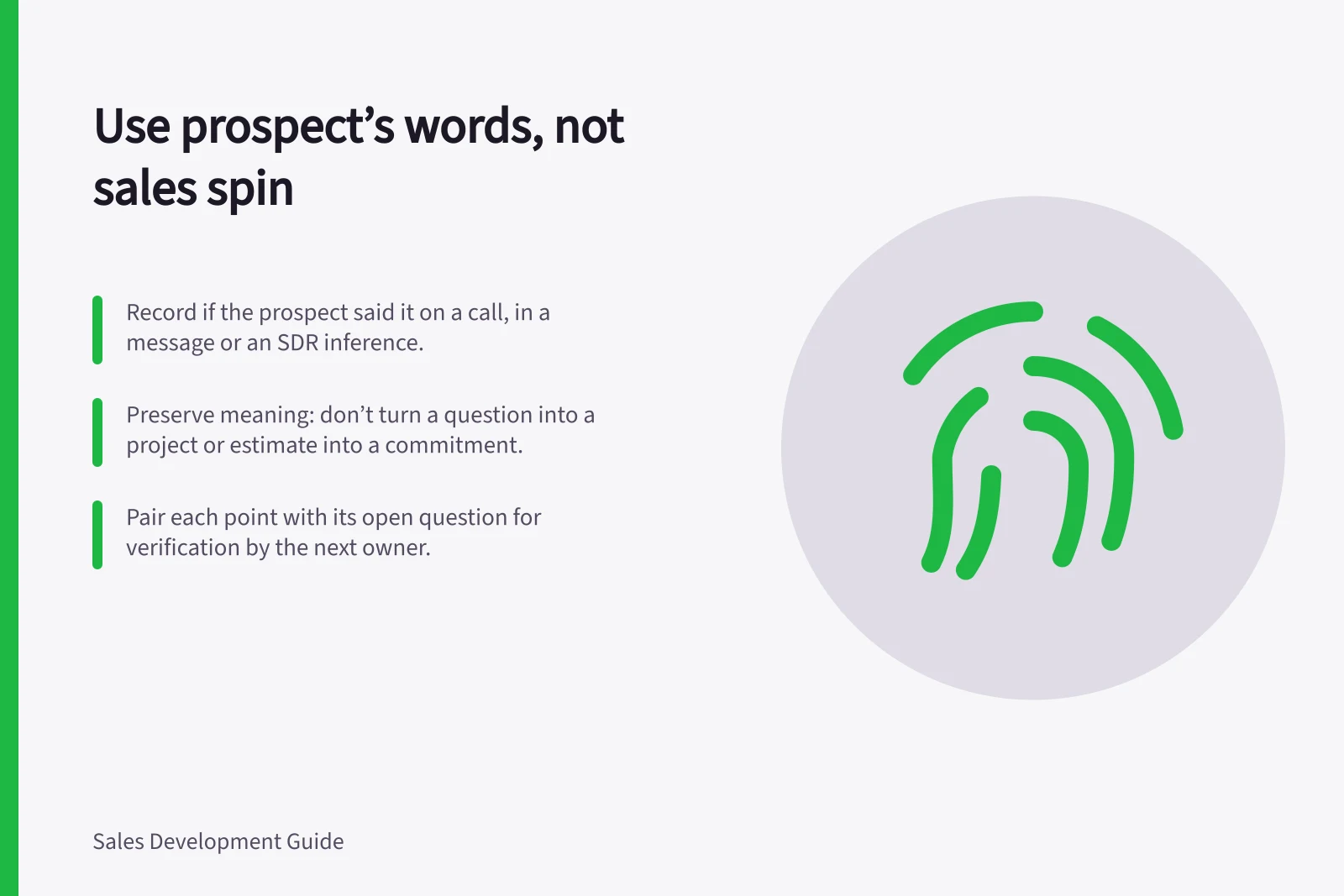
Pass on what the prospect actually described, the context in which they said it and a separately labelled SDR interpretation. Preserve the person’s meaning without turning a question into a project, an estimate into a measurement or a polite reply into buying intent.
Identify the source of each important point
For any statement that shapes the proposed next action, record whether the prospect said it on a call, wrote it in a message or the SDR inferred it from another source. Include when it was said and who could speak to it. A contact may know their own workflow without being able to confirm another team’s budget or technical policy.
Labels such as prospect stated, prospect estimated, SDR inference and unverified stop tentative points looking settled in a CRM field. They also show the receiving salesperson what can safely be repeated and what needs checking.
Preserve the scope of the statement
Suppose a contact asks whether their current system can provide data required by a service. The handoff can say they asked about data availability and that compatibility needs checking. It cannot say they approved an integration, their system is failing or their organisation has begun a buying project.
Treat quantities and timing the same way. A rough estimate of monthly work remains an estimate. A hope to review options later in the year is not a confirmed purchase date. A colleague who may know an answer is not automatically an agreed decision-maker.
An indirect summary is often enough. Use quotation marks only when exact wording matters to the next decision and can be checked against the source. Do not reconstruct speech from memory as a verbatim quote.
Australian Privacy Principle (APP) 4 – Accuracy of Personal Information
- RequirementEnsure personal information is accurate, up to date, complete and relevant.
- Relevance to SDRsApplicable to all organisations handling personal data under APPs, including Australian businesses using CRM systems.
Give the next owner a way to verify
Pair each important point with its open question. For example: Known: the contact asked about an export from their current system. Open: the required format and permissions. Next action: check the requirements before promising compatibility. The SDR may recommend that action while keeping the recommendation distinct from the contact’s request.
Before transfer, compare the summary with the underlying note or message. Which claims might the salesperson repeat to the prospect? Would the prospect recognise them as an accurate account?
Label or remove any assumption required to make a sentence true. If the prospect later clarifies a point, correct the current record.
For APP entities, Australian privacy guidance requires reasonable steps to ensure personal information used or disclosed is accurate, up to date, complete and relevant for its purpose. That obligation depends on the information and entity involved; the practical handoff rule is to make the source and uncertainty visible.
Best Practice for Handing Off Prospect Information
- Identify the source of each statementLabel as **prospect stated**, **prospect estimated**, **SDR inference**, or **unverified**.
- Preserve scope and contextDo not convert an estimate into a commitment or a question into a project.
- Include open questions for verificationPair each point with what’s still unknown, e.g., 'Required export format? Permissions needed?'
- Verify against original source before transferCross-check summary with notes or messages to ensure accuracy.
- Correct if prospect clarifies laterUpdate CRM record promptly when new information is provided.