SDR Operations
Outbound programme improvement
Locate an outbound programme gap, test a defined change and review replies, meetings and sales decisions without confusing activity with progress.
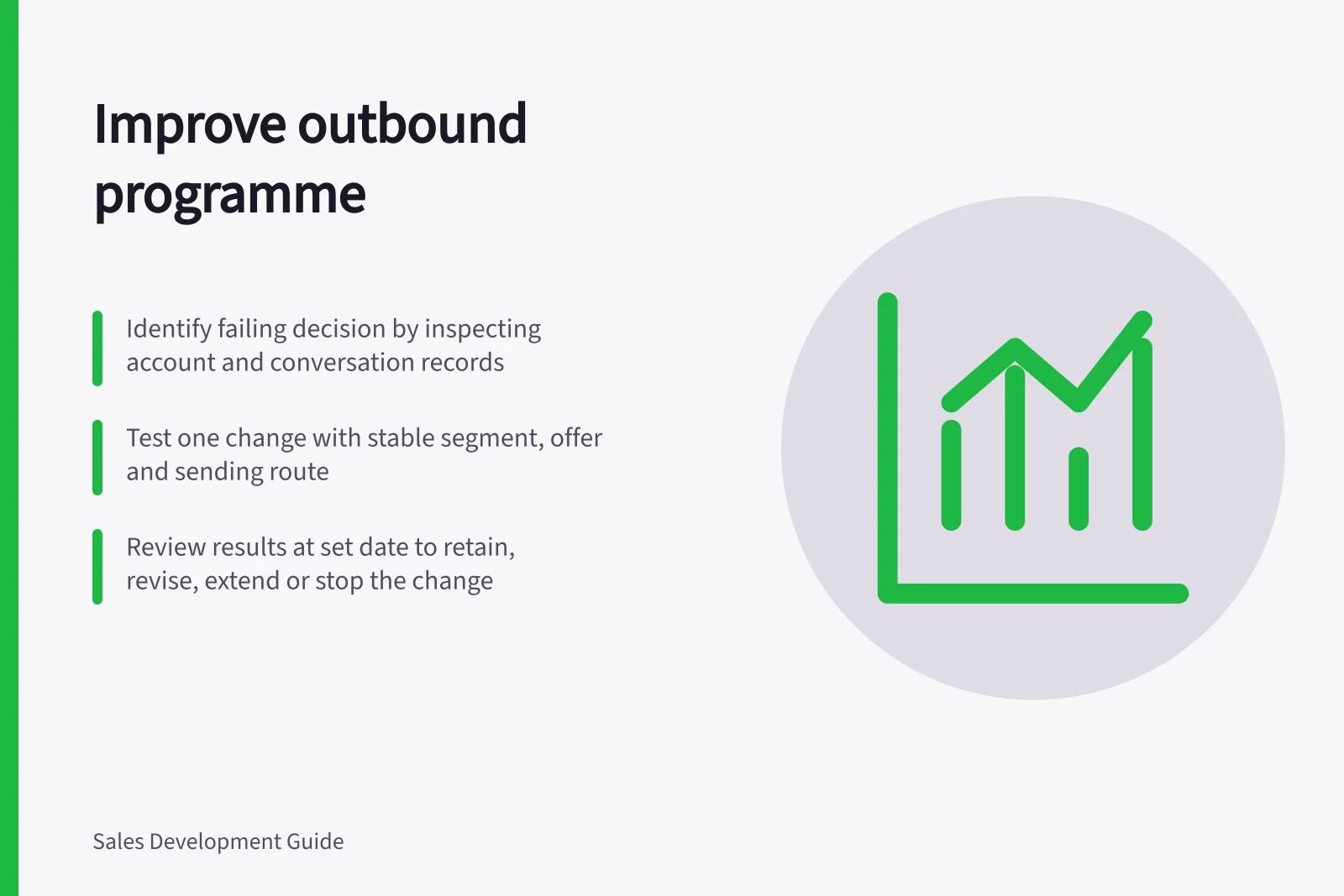
Improve an existing outbound programme by diagnosing which decision is failing, reconstructing the evidence in account and conversation records, and testing one defined change. Review the result at a pre-set date, then retain, revise, extend or stop the change.
Locate the decision that needs work
Before opening a dashboard, agree the intended audience, current offer and useful outcome. Keep attempts, human replies, relevant conversations, meetings and later sales decisions separate.
| Pattern | Records to inspect | Decision to consider |
|---|---|---|
| Few human replies | Delivery responses, account fit, contact roles and actual messages | Check the route, audience or message premise |
| Many replies, little relevant discussion | Reply content and the question asked | Revise the premise or proposed next step |
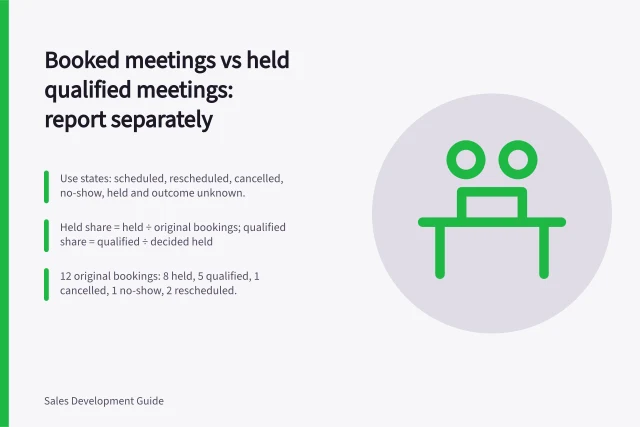
| Many meetings, weak sales follow-through | Booking reasons, prospect statements and receiving-owner decisions | Review meeting purpose and fit rules |
| Useful conversations concentrated in one account group | Account traits and observation periods | Test a narrower segment |
| Suitable prospects understand the proposal but decline its value or terms | Their stated reasons and the offer’s limits | Consider an offer change |
Treat these as investigation paths, not diagnoses. Silence alone cannot identify a poor message, and a meeting count cannot establish opportunity quality. Start at the earliest stage where the cohort diverges from the intended outcome, then inspect the decision governing that stage.
Investigation Paths for Outbound Programme Issues
- Issue: Few human repliesCheck route, audience, or message premise
- Issue: Many replies, little relevant discussionRevise message premise or proposed next step
- Issue: Many meetings, weak sales follow-throughReview meeting purpose and fit rules
- Issue: Useful conversations in one account group onlyTest a narrower segment
- Issue: Prospects understand but decline value or termsConsider an offer change
Reconstruct one cohort
Choose accounts first worked during a defined period and set a later review date. Give each account a stable ID so additional contacts and rescheduled meetings do not inflate account-level results; record the segment, sending route, message version, first attempt date and owner.
Follow the accounts through delivery responses, human replies, relevant conversations, meetings and receiving-owner decisions. Show outcomes still pending at the review date.
State each denominator. Replies per attempted message and accounts with a reply per contacted account answer different questions. Keep automatic responses, declines and stop requests in separate categories; a decline may explain a weak premise even though it does not advance a sale.
Read records alongside counts. Clustered rejections after a route change warrant a delivery check. If available delivery evidence shows no clear fault, inspect whether the organisations can use the offer, whether the contacted roles own the work and whether the message raises a recognisable question. A sending system's accepted status does not show that a person saw or welcomed the email.
Add relevant account context to the review record: company size, industry, budget, business objectives, current challenges and decision-makers. These details can distinguish a conversation problem from a mismatch between the organisation's circumstances and the offer.
Choose a change with a reason
Write down the observed gap, the records supporting it, the explanation to test and the exact change. State the outcome that would affect the next decision before launching the test.
For example, test adding one researched current challenge to the message, while holding the segment, offer and sending route stable where practical. Compare relevant conversations per contacted account for eligible accounts receiving the revised and existing messages, and record any outcomes still pending.
Keep other material conditions as stable as practical. If the segment, offer, sending route and message all change together, record each change and limit the conclusion. Set the observation period before launch so a newer cohort is not judged while many responses remain pending.
Where a comparison is possible, use eligible accounts from comparable periods and record differences in account mix, owner and channel. If accounts are assigned to alternative approaches, avoid placing all of one account type in one approach; membership in an existing segment cannot itself be randomly assigned. A small or uneven pilot can reveal useful cases without establishing a general effect.
When several possible causes are under investigation, name the factors before choosing the test. Select the design objective and number of factors to match the decision the team needs to make.
Protect contact and handoff rules
Before adding contacts to a revised approach, check account ownership, applicable Australian spam requirements and any recorded stop requests. Consult the Australian Communications and Media Authority (ACMA)'s Avoid sending spam guidance as part of that review.
Tell receiving sales owners what the change is testing. Keep the acceptance rule stable or document when it changes, because a movement in accepted opportunities may reflect the rule rather than the prospects. Preserve the prospect's stated question and material unknowns in each handoff.
Key Compliance and Best Practice Guidelines
- ACMA Spam Guidance
- Required reading before adding contacts
- Email Delivery Status
- Does not confirm recipient saw or welcomed message
- CRM Capability Standard
- Refer to Australian Digital Government Architecture for CRM practices
Match the test to the question
Use a comparative design when one preselected factor is the main question, even when other factors are present. This tests whether different levels of that factor change the defined outcome.
Use a screening design to select or screen the few important main effects from many possible factors. This suits a test intended to identify which factors merit further attention.
Choose a response surface method (RSM) design when you need to estimate interactions and quadratic effects. RSM designs can help find improved process settings or troubleshoot process problems and weak points.
Select the design according to the experiment's objective and the number of factors being investigated.
Experimental Design Options for Testing Changes
- Comparative Design
- Best when testing one preselected factor; isolates impact of that variable
- Screening Design
- Ideal for identifying key factors among many possible influences
- Response Surface Method (RSM)
- Used to estimate interactions and quadratic effects; finds optimal settings
Decide what happens next
At the review date, report counts, pending outcomes, reasons found in the records and material differences between groups. Compare the result with the outcome set before launch, then retain, revise, extend or stop the change and name its owner.
Repair an identified route problem before drawing conclusions about the audience. Examine the offer when suitable prospects understand it but repeatedly reject its value or terms. If evidence is thin, keep the conclusion narrow and identify the next useful check.
Record the decision beside the programme version so the next review can see what changed and why. Record the next review date as well.
In this guide
- Diagnosing a low reply rate by audience and messageSeparate delivery failures from audience and message questions, then choose a bounded check for a low outbound reply rate.
- Investigating high meeting volume with weak opportunity qualityTrace bookings through prospect purpose, held discussions and sales decisions to find where opportunity quality weakens.
- Testing a narrower account segmentDefine a checkable segment, compare eligible account groups and decide whether a narrower outbound focus deserves another round.
- Deciding when an outbound offer needs to changeUse prospects’ stated reasons and delivery limits to decide whether to clarify the message, change the ask or revise the offer.