SDR Operations
SDR-to-sales handoffs
Agree on an SDR handoff record, give sales a clear acceptance decision, introduce the next owner and record what happens next.
An SDR-to-sales handoff transfers responsibility for an agreed next action. It is complete when a named sales owner accepts that responsibility and the prospect understands who will do what next.
The team should then record what happened. A calendar booking alone establishes none of those decisions.
Agree on the transfer decision
Before SDRs submit meetings, agree on what the receiving salesperson is being asked to decide. Did the prospect raise a question worth exploring?
Can the current offer plausibly help? Which material requirements remain unknown? What next action did the prospect accept?
A handoff does not require a complete buying plan. Budget, timing or technical fit may still be open. The record should show which gap the next action will resolve. A confirmed requirement the offer cannot meet calls for a different decision, not a broader meeting invitation.
| Point in the handoff | Decision to record | Owner |
|---|---|---|
| SDR proposes the transfer | Why this prospect and next action appear relevant | SDR |
| Sales reviews it | Accept, return for a specific correction, or redirect | Receiving salesperson |
| Prospect is introduced | Who will attend and what the discussion is for | Agreed contact owner |
| Next action occurs | What happened and who owns the follow-up | Action owner |
SDR-to-Sales Handoff Process
- SDR proposes transferWhy this prospect and next action are relevant
- Sales reviews handoffAccept, return for correction, or redirect
- Prospect introducedWho will attend and purpose of discussion
- Next action occursWhat happened and who owns follow-up
Give the next owner a usable account
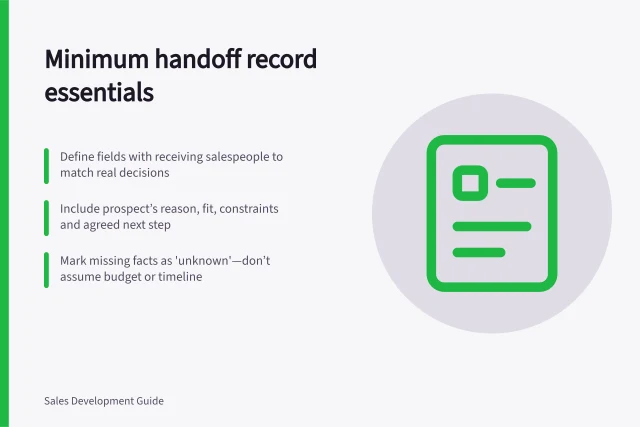
The salesperson needs the account and contact, the prospect’s description of the issue or question, relevant constraints, material unknowns and the action the prospect accepted.
Keep those statements separate from the SDR’s assessment. “Interested in a demonstration” misstates an exchange if the person only asked whether a particular system could connect.
Include information that changes the next decision. Leave out copied research, unnecessary personal details and speculative buying signals.
For organisations subject to the Australian Privacy Principles, APP 3 limits collection of solicited personal information to what is reasonably necessary for their functions or activities. APP 10 requires reasonable steps to keep personal information used or disclosed accurate, up to date, complete and relevant for that purpose.
Point to an existing current record where possible rather than creating competing accounts. Check ownership before introducing a new salesperson, especially if a customer owner or active opportunity already exists.
Keep collection limits in view when deciding what personal information to pass across. Under APP 3, sensitive information has additional conditions: the person’s consent is generally required unless an exception applies, and collection must use lawful and fair means.
Where practicable, collect personal information from the individual concerned. If the SDR did not obtain information directly, note its origin so the receiving owner can judge its relevance and accuracy before using it.
Key Requirements for a Valid Handoff
- Account and contact records availableYes
- Prospect’s issue or question clearly statedYes
- Relevant constraints and unknowns recordedYes
- Action accepted by prospect documentedYes
- Personal information collected under APP 3 & 10Yes
Australian Privacy Principle (APP) Compliance in Handoffs
- APP 3 – Collection Limitation
- Only collect personal information reasonably necessary for function
- APP 10 – Data Quality
- Ensure accuracy, up-to-date, complete and relevant information
- Sensitive Information Handling
- Consent generally required unless exception applies
Make acceptance explicit
Name who can accept or return a handoff and set a review point that allows preparation for the agreed action.
A return should identify the obstacle: a confirmed offer mismatch, missing context, disputed ownership or a change in the prospect’s plans. “Bad lead” gives the SDR nothing to resolve.
In Dynamics 365 Sales, qualification behaviour depends on configuration. Automatic creation can create records; with it off, a side pane offers create, reuse or skip for contact and account records.
If no opportunity is created, the lead can still be marked Qualified, but the business process flow does not advance. None of these events confirms that a named sales owner has accepted responsibility; record that decision separately.
An internal question may remain unresolved. While it is resolved, keep someone responsible for any answer or invitation already promised to the prospect.
Handoff Decision Outcomes
- Accept
- Sales owner takes responsibility; proceed with agreed action
- Return for correction
- Specific gap identified: missing context, ownership dispute, offer mismatch
- Redirect
- Handoff sent to different salesperson or team based on criteria
Introduce the conversation accurately
Once the sales owner accepts, confirm the purpose and participants with the prospect. Do not announce an approved project, urgency or purchasing authority that the prospect did not establish. If the person asked whether a service works with an existing platform, a focused technical check may answer the question more directly than a broad demonstration.
Follow through
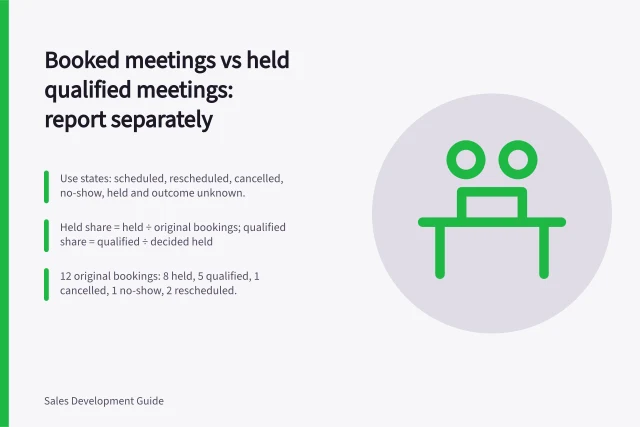
Record whether the agreed discussion took place, was rescheduled, was declined or needs another action. If it took place, record whether it addressed its stated purpose and what each side agreed to do next. Attendance alone does not establish qualification; a later opportunity record does not establish that the original handoff was sound.
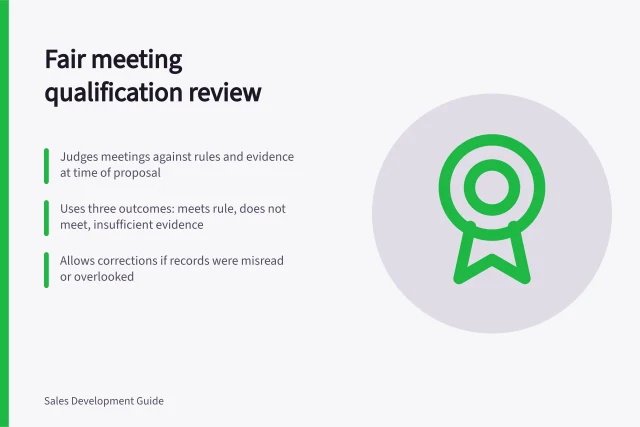
Preserve the acceptance decision when later facts change the opportunity. Review repeated returns against the information available at submission. Missing context may call for a clearer record; a disputed threshold calls for a rule both teams can apply to future handoffs.
In this guide
- Agreeing on a minimum useful handoff recordChoose the fields a receiving salesperson needs to accept and prepare for an SDR handoff, then check the template against real decisions.
- Passing the prospect's own words rather than inflated claimsKeep prospect statements, estimates, SDR inferences and open questions distinct so the next salesperson starts from an accurate account.
- Tracking what happens after a meeting is acceptedFollow an accepted SDR meeting through attendance, its stated purpose and the next owner while keeping reschedules and later changes distinct.
- Resolving repeated handoff disagreementsReview recurring SDR handoff disputes by evidence, fit and ownership, then agree a rule for future decisions while keeping prospect commitments owned.