SDR Operations
Part of Sales development qualification
Recording uncertainty in a qualification note
Distinguish confirmed facts, estimates, seller inferences and unknowns so the next sales decision uses the right evidence.
A qualification note should show what is known, inferred and still unchecked before anyone acts. “Qualified” without that distinction can send a colleague into a meeting with confidence the conversation did not earn.
Separate the types of information
Use plain labels, not a single confidence score:
- Confirmed in the conversation:A point the prospect clearly stated or corrected. Note who provided it and when, if known.
- Estimate:A figure or frequency the prospect offered without a measured source. Retain the word “estimate”.
- Seller inference:Your interpretation of what the information may mean for fit. State the basis.
- Unknown:A decision-relevant question no one answered.
- Next check:Who will resolve the unknown, by what action and before which decision, where agreed.
A label describes the evidence, not the prospect’s honesty. Someone may describe their own workflow accurately while unable to speak for procurement or IT. Do not fill that gap with a guess.
Types of Information in a Qualification Note
- Confirmed in the conversationProspect clearly stated or corrected. Include source and date if known.
- EstimateFigure or frequency provided without measured source. Retain the word 'estimate'.
- Seller inferenceYour interpretation of meaning for fit. State the basis.
- UnknownDecision-relevant question unanswered.
- Next checkWho will resolve the unknown, by what action and before which decision, where agreed.
Make uncertainty actionable
A note is most useful when each unknown changes a decision. “Budget unknown” is incomplete. “Whether the team can fund an external service is unknown; the contact will ask the programme owner before a technical meeting is proposed” tells the next reader what to do, if that action was agreed. If the answer would not affect the next action, it may not need to be collected now.
A hypothetical compact note:
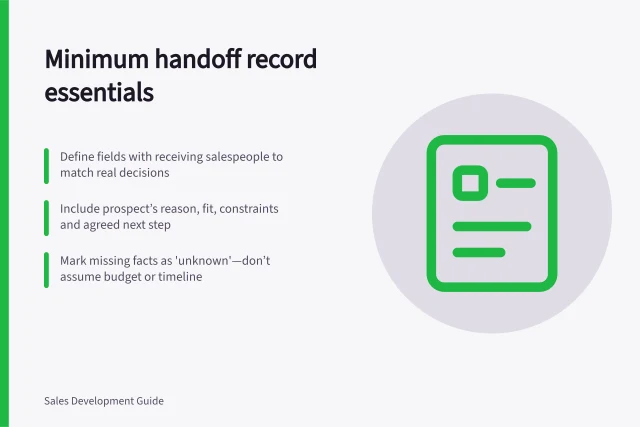
Issue reported: Monthly reporting requires a manual reconciliation after data is transferred between two systems. The contact described this as recurring work; its time cost and the number of corrections were not measured on the call.
Fit assessment: The offer might address the transfer step, subject to integration requirements.
Unknown: Whether the required systems permit the connection.
Next check: Send the integration requirements for the contact to review with the system owner. Decide on a demonstration only after that check.
This preserves a possible opportunity without declaring the integration feasible or inventing a saving.
Actionable Uncertainty Workflow
- Identify the unknownClarify what is not yet known and why it matters to the next decision.
- Assign ownership and timelineDefine who will resolve it, how, and by when—only if agreed with the prospect.
- Link to next decisionEnsure the unknown directly impacts the next step; otherwise, defer collection.
- Document clearlyUse plain labels so the next reader knows what’s fact, assumption, or pending.
Write for the next decision
Start with the problem and its source. Add the consequence, the constraint that could defeat fit and the action agreed with the prospect. Include an owner and timing only if they were agreed. If someone declines a meeting, record that decision accurately; do not reframe it as a delay.
Keep personal details out unless they are needed for the business purpose. Use the organisation’s approved record system and access rules.
For organisations subject to the Australian Privacy Principles, APP 3 limits collection of personal information to what is reasonably necessary for their functions or activities. Whether those principles apply to a particular organisation, and what may be recorded, requires assessment in context.
Before saving the note, check whether another representative could tell which statements came from the prospect, which are your assessment and what still needs verification. If not, revise the labels rather than adding a more confident summary.
Review Before Saving a Qualification Note
- Can another representative tell which statements came from the prospect?Yes – ensure clarity through labels.
- Are assessments clearly separated from facts?Yes – use distinct labels like ‘seller inference’.
- Is every unknown tied to an action and owner?Yes – only include if agreed with the prospect.
- Have personal details been kept only if necessary?Yes – aligns with APP 3 under Australian Privacy Principles.