SDR Operations
Part of SDR-to-sales handoffs
Resolving repeated handoff disagreements
Review recurring SDR handoff disputes by evidence, fit and ownership, then agree a rule for future decisions while keeping prospect commitments owned.
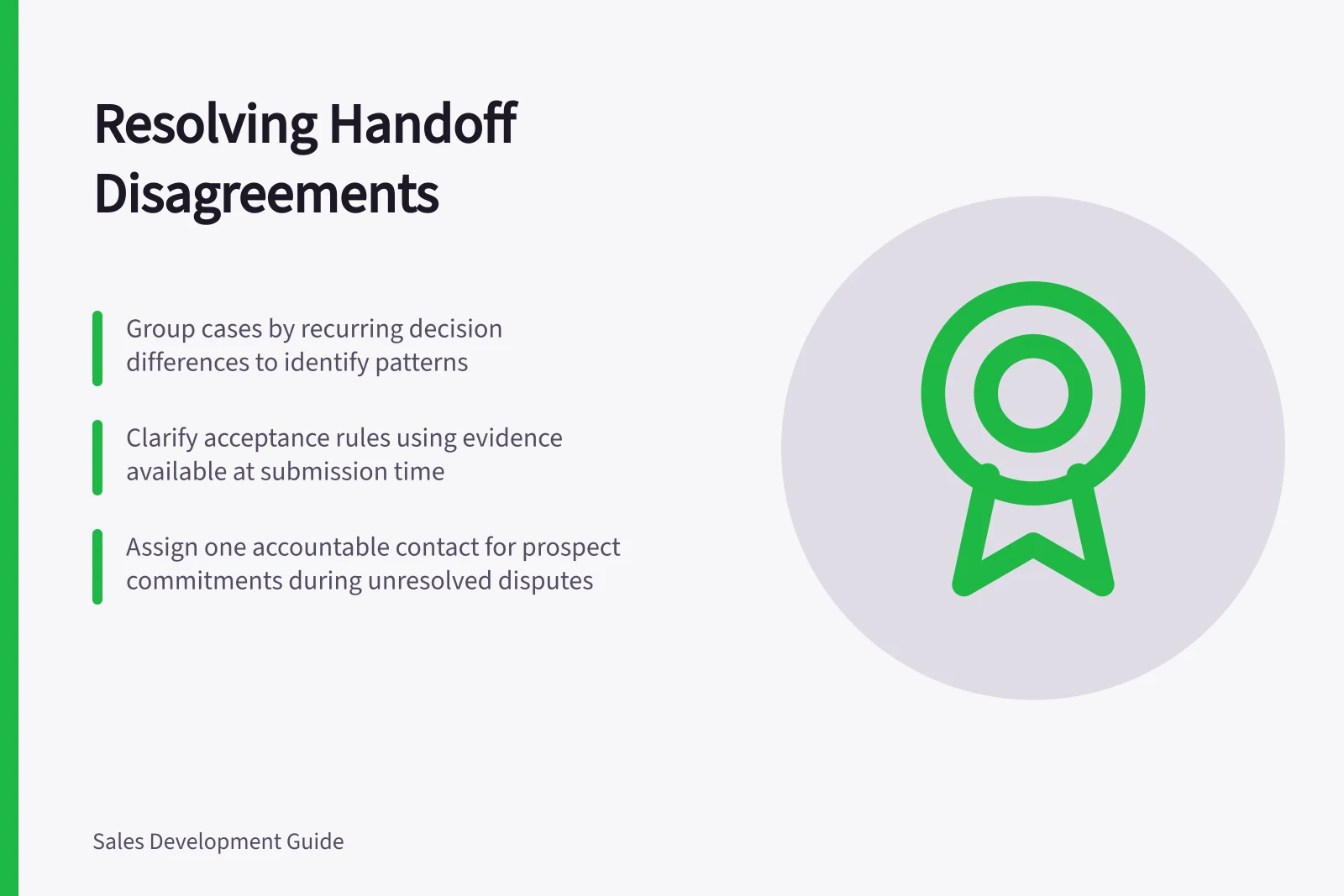
When SDRs and sales owners disagree about handoffs again and again, review the cases together and clarify the rule for future decisions. Separate missing evidence from differing judgements on the same evidence. While the internal question is unresolved, keep one person accountable for any action already promised to the prospect.
Identify the recurring question
A return reason should state what prevents the proposed action. Group cases by the decision on which the teams differ:
| Disagreement | Inspect | Rule to clarify |
|---|---|---|
| SDR sees interest; sales sees no reason to continue | The prospect’s actual question or request | What evidence supports the next action? |
| Sales says the record is incomplete | The fact missing at acceptance | What must be known now, and what may stay open? |
| Teams disagree about fit | The current offer’s requirements and stated constraints | Who confirms a disputed service limit? |
| Two sales owners reject ownership | Account history and assignment rule | Who resolves routing before an introduction? |
| Sales rejects a meeting after new facts emerge | Evidence available at submission and the later finding | How are later changes recorded? |
A returned handoff can have more than one material reason. Record each one rather than forcing it into a vague “bad lead” category.
Review the evidence available at the time
Choose accepted and returned examples from the recurring pattern. Put the SDR’s submission, the receiving owner’s response and any prospect correction in chronological order.
Ask what each person could reasonably know at submission. Later disqualification may reveal a useful new fact, but it does not prove the original proposal broke the rule in force then.
If wording is disputed, compare the handoff with what the prospect said. If a CRM status is disputed, establish what the team’s configuration records.
In Dynamics 365 Sales, for example, an administrator can set opportunity creation during lead qualification to occur automatically or by seller decision. A created opportunity therefore needs a local definition before it is treated as proof of receiving-owner acceptance.
Write a rule both teams can apply
State the acceptance threshold, permissible unknowns, specific return reasons, decision owner and escalation path. Test the proposed wording against the reviewed cases to see whether it resolves the disagreement. Give the rule an effective date so earlier decisions remain interpretable under the rule used at the time.
A technical requirement may need a specialist check before acceptance. Missing context may call for one clearer field. An ownership dispute may need routing before the SDR offers a meeting. Do not make every field mandatory because one unusual case required it.
Give the prospect one accountable contact throughout the review. Deliver an agreed answer, or explain a necessary change to the proposed action. At the next review, compare new cases with the revised rule and clarify any ambiguity that persists.
Balancing Flexibility and Clarity in Handoff Rules
- Pros of Clear RulesReduces repeated disagreements, improves accountability, ensures consistency under ATO-style compliance standards.
- Cons of Overly Rigid RulesMay stifle SDR initiative; could require mandatory fields that don’t apply universally across Australian market segments.
- Pros of Flexible InterpretationAllows adaptation to unique customer needs, especially in complex B2B contexts like Australian superannuation tech solutions.
- Cons of Vague GuidelinesLeads to subjective decisions, undermines trust between SDRs and sales owners, increases risk of non-compliance with CRM governance.