SDR Operations
Sales development operations
Set practical rules for account ownership, meeting reviews, sequence changes and SDR workload without relying on activity counts alone.
Sales development operations sets the day-to-day rules for who works an account, how meeting decisions are reviewed, how sequence changes are recorded and whether the team can handle its workload. Each rule needs an owner and a way to resolve exceptions. A dashboard cannot settle an ownership dispute or explain why a prospect received two approaches.
Set ownership rules before assigning work
Choose the account record that controls assignment, and name the person who resolves exceptions. A territory may be based on geography, industry or named accounts, but the team still needs rules for subsidiaries, existing customers and active opportunities that cross those boundaries.
| Decision | Rule to record | Exception owner |
|---|---|---|
| Account enters the queue | Which account record and territory apply? | Sales operations or the assigned manager |
| Another team has a relationship | Who may approach the account, and who must be consulted? | Current account or opportunity owner |
| Territory changes | Who handles open conversations and scheduled actions? | Managers of both territories |
| Ownership is disputed | Who decides before further contact? | Named escalation owner |
Account ownership is separate from permission to contact a person. For Australian guidance on spam, see the Australian Communications and Media Authority page titled “Avoid sending spam”. Reassigning an account does not erase a contact’s preference.
Make meeting decisions reviewable
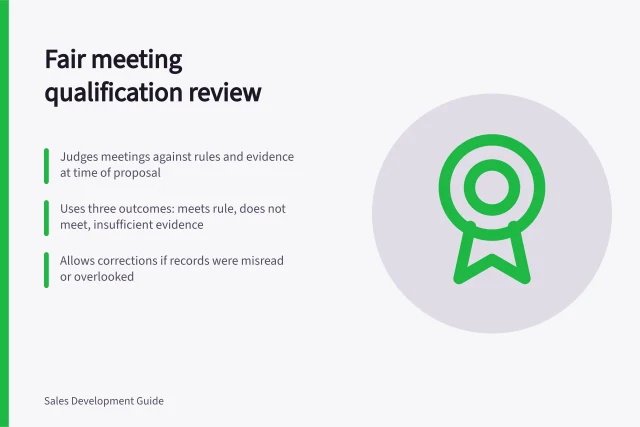
Agree on a qualification rule with the people who receive meetings. State what the prospect must have expressed, which offer limits matter and what the next discussion would answer. Say which unknowns may remain open. A booking can fail the rule; a useful exchange can end without a booking.
Review a disputed decision against the evidence available when the meeting was proposed. Record the reviewer’s decision and reason separately from later developments. A technical mismatch discovered on a later call may explain why work stopped without proving that the original decision was unreasonable. Give any revised rule an effective date so earlier cases remain interpretable.
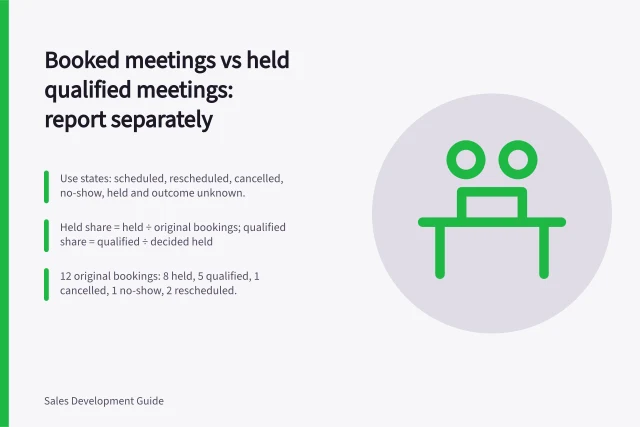
Reporting on booked, held and qualified meetings needs separate definitions and denominators.
Treat the handoff to the closing team as a separate control. Before passing a qualified lead, have the representative update the CRM with the activity and lead status so the recipient can distinguish a lead ready for handoff from one still being researched or contacted.
Record sequence edits as versions
Give each sequence a named owner. Record its audience, message, timing, exit rules and sending route.
Before an edit, state the question it is meant to answer. Preserve the previous version and its start date instead of silently overwriting it while contacts remain enrolled.
Record who approved the change, which contacts remain on the old version, which receive the new one and what happens to queued steps. If the message, audience and sender route change together, a later difference in replies cannot safely be attributed to the wording alone.
Review useful replies alongside declines, opt-outs and delivery failures. Have a process to action unsubscribe requests and stop relevant queued marketing.
When documenting a sequence, identify which outreach channels its steps use, such as calls, email or LinkedIn. Keeping the channels visible alongside the sequence version makes it easier to establish what a contact received when a question or exception is reviewed.
Inspect work waiting as well as work completed
An active account may require an ownership check, research, permitted contact, reply handling and a recorded outcome. Inspect the queue: how old are unanswered replies and unresolved ownership questions? Are specialist checks delaying several decisions? Can representatives revisit the accounts already assigned to them?
Attempts and bookings describe volume, but neither establishes usefulness. Review the reasons behind outcomes and justified stops. Account complexity, inbound interruptions, territory mix and available time matter when comparing workloads.
Use the operating review to clear exceptions
Hold a weekly operating review covering disputed accounts, pending qualification decisions, sequence versions in use and overdue work. Raise exceptions as they arise rather than waiting for the review if ownership is blocking work, a meeting decision is disputed before handoff, a sequence change affects enrolled contacts or a queue item is delaying a response.
For each issue, record the decision, owner, reason and next review point. Correct an individual record when the rule is clear; revise the rule when it repeatedly produces disagreement. Changes to the target market, offer or wider outbound strategy require a separate decision.
In this guide
- Planning account ownership across territoriesDefine account and conversation owners, test territory edge cases and transfer open work without duplicate outreach.
- Building a fair meeting qualification reviewReview meeting decisions against the rule and evidence available at the time, with clear reasons, uncertainty and a correction path.
- Recording sequence changes and their resultsKeep a usable sequence change log, preserve stop rules and interpret results with comparable groups and clear limits.
- Monitoring workload without rewarding meaningless activityReview active work, waiting replies and decision quality alongside activity counts, then act on the capacity constraint.