Deliverability
Part of Checking sales-sequence delivery before and after launch
Separating technical delivery issues from poor targeting
Use delivery events, authentication and account records to assess whether weak outbound response reflects a mail-system issue or poor targeting.
A low reply rate cannot show whether messages failed in transit or reached an unsuitable audience. Review delivery evidence for a defined batch, then inspect the recipient and message choices. If the evidence does not distinguish the causes, record the result as uncertain rather than declaring either one.
Compare a defined batch
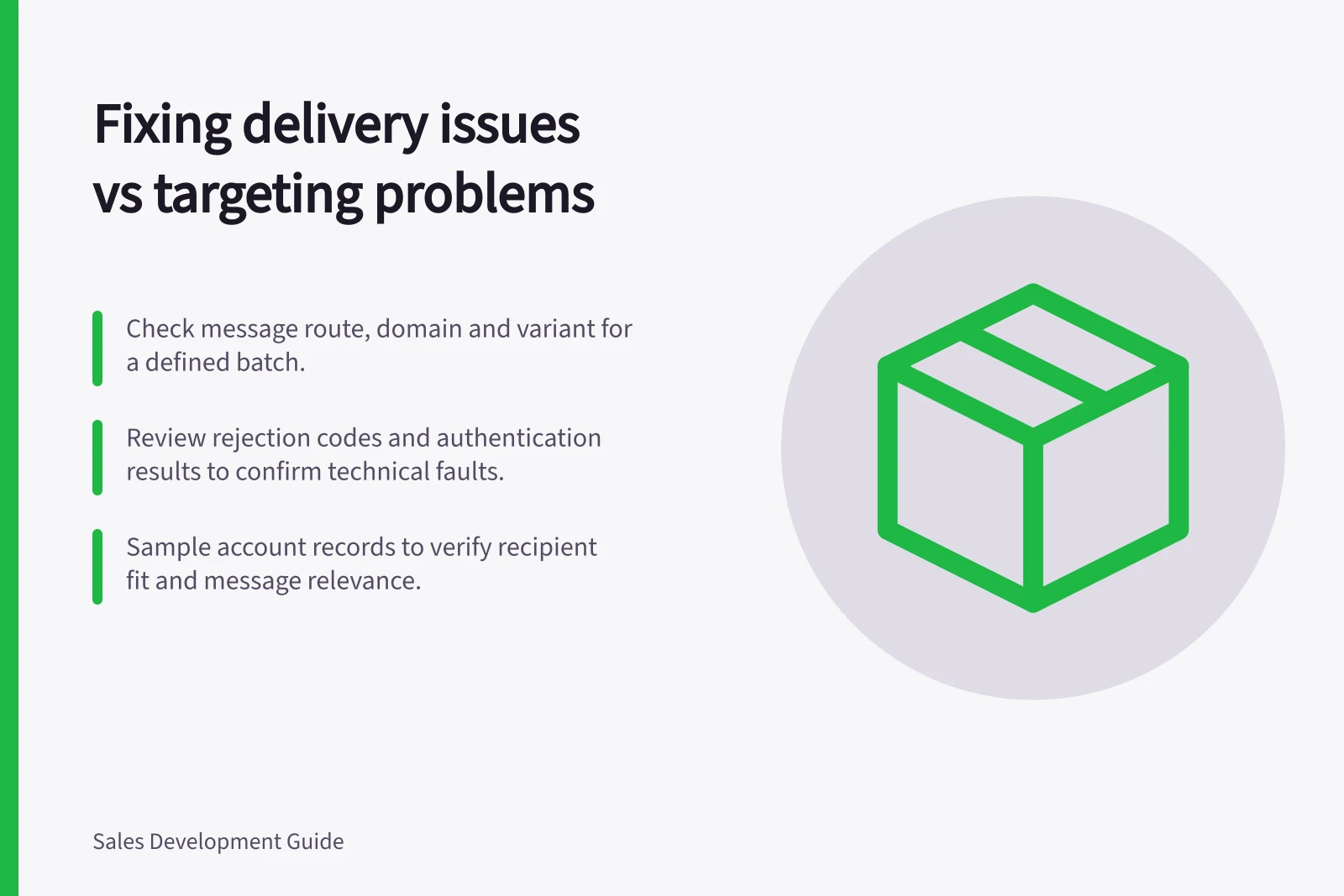
Select messages that share a period and a clear sending setup. Record the route, From domain, recipient domain, message variant and account segment. Count attempted sends, rejections, deferrals, messages reported as delivered by the sending service, replies, negative replies and opt-outs. Keep definitions consistent: a tool’s “sent” label is not proof that a person received the message.
Look for concentration: failures beginning after a route change, deferrals clustered at one receiving domain, or unrelated domains failing together. Such patterns justify a mail-system investigation.
For teams using Exchange Online, message trace can show whether that service received, rejected, deferred or delivered a message. Its status does not establish that a person read it.
Check the limits of technical signals
Read the full response for rejected mail and inspect authentication results from the affected route.
Acceptance by a receiving service is a transport observation, not proof of inbox placement or attention. Open tracking is a weak deciding signal; do not use an open rate alone to diagnose delivery.
Inspect fit and message relevance
For messages without a recorded delivery failure, sample account and contact records. Can the business serve the account? Does the recipient’s role relate to the problem? Is the reason for contact based on a verified fact? Read the actual message beside the account note.
Negative replies can identify a poor market match or the wrong contact. An irrelevant premise can weaken response even when the mail path works. Record the reason in plain language and change one clear assumption in the next small, permitted batch.
Make a bounded decision
If failures cluster by route or receiving service, pause the affected route for administrator review. If the available delivery evidence raises no fault and the sample repeatedly shows fit errors, narrow the audience or revise the premise.
A clean delivery log still cannot prove inbox placement. If both technical and targeting problems appear, address permission and delivery failures before interpreting response rates. Document the evidence and the change so the next review can test the explanation.