Ideal Customer Profiles
Part of Outbound programme improvement
Testing a narrower account segment
Define a checkable segment, compare eligible account groups and decide whether a narrower outbound focus deserves another round.
Test a narrower account segment when a specific reason suggests one group may get more value from the current offer. Define the group and the decision before selecting accounts. The test can guide the next outbound queue; it cannot declare every organisation outside the group a poor customer.
State the segment hypothesis
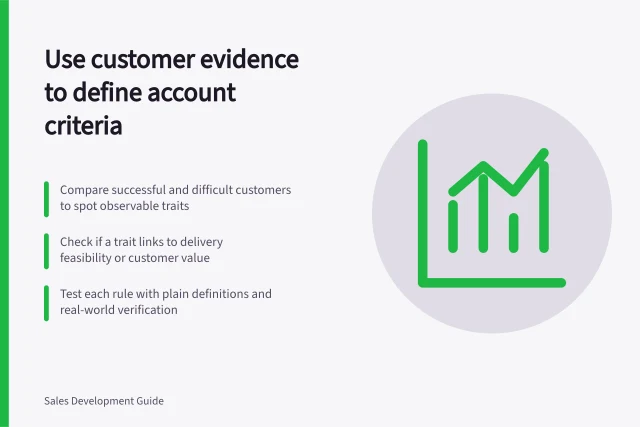
State a condition a researcher can check, such as an operating process, supported system or service location. Explain why it may matter to the offer. “Mid-market companies” is weak if the hypothesis actually concerns teams coordinating a particular workflow across sites.
Set include, exclude and unknown rules. A blank CRM field is not evidence that an account lacks the trait. A confirmed service mismatch excludes an account for the present offer. An account outside the proposed narrow segment may still be serviceable and belong in a different queue.
A fictional supplier, for example, might consider organisations operating several sites with a supported record system. It would need a way to check both conditions. This example does not claim that such accounts perform better.
Design a comparison you can interpret
Choose the reporting unit before launch, usually the account for an account-level segment decision. Select accounts from a defined eligible pool and record why each entered it. Compare the proposed narrow group with a broader, serviceable group over a similar period where practical. Keep the offer, message purpose, sending route and follow-up rules as consistent as possible.
Account traits cannot be randomly assigned: the groups may differ for reasons beyond the proposed segment condition. Record material differences such as account size, prior relationship, owner and timing.
If representatives or message approaches can be assigned across eligible accounts, distribute those conditions rather than putting one whole group with one owner. This can reduce a source of bias but does not turn a small observational segment comparison into a causal experiment.
Choose outcomes that match the queue decision. Relevant human replies and useful conversations show whether the premise opens a discussion. Held meetings with a stated purpose and receiving-owner decisions help show whether it merits sales time.
Report opt-outs, confirmed mismatches and pending outcomes too. Give both groups a comparable chance for later outcomes to occur.
Protect eligibility
Before contact, confirm account ownership, the person’s consent basis and stop status. For Australian commercial electronic messages, check the current Australian Communications and Media Authority guidance on avoiding spam. Segment membership is not consent. Do not add a person merely to fill a comparison group.
Save the segment rule, source and date for decisive account facts, message version and exception decisions. If a required trait is unknown, assign a check or leave the account out of the active batch; do not silently treat it as a match.
Decide what the result warrants
At the review date, show group sizes, relevant outcomes and unresolved cases. Read positive and negative replies. A narrow group with a higher relevant-reply share but more disqualifying requirements may not be the better focus. A small difference across a few accounts may be too uncertain to change the program.
Choose a bounded action: use the segment for the next queue, revise its definition, extend the comparison or reject the hypothesis. Preserve the broader group’s records. The decision allocates the next round of work under the current offer; it is not a permanent market boundary.