Ideal Customer Profiles
Part of Outbound programme improvement
Investigating high meeting volume with weak opportunity quality
Trace bookings through prospect purpose, held discussions and sales decisions to find where opportunity quality weakens.
When outbound books many meetings but few become worthwhile sales work, trace each booking through the prospect’s stated purpose, the held discussion and the receiving salesperson’s decision. Find the earliest avoidable break before changing a target or blaming a handover.
Keep the stages separate
Choose meetings first booked in a defined period and give each intended discussion one ID. Link reschedules to that ID. At a review date, show how many were held, cancelled, missed or still pending.
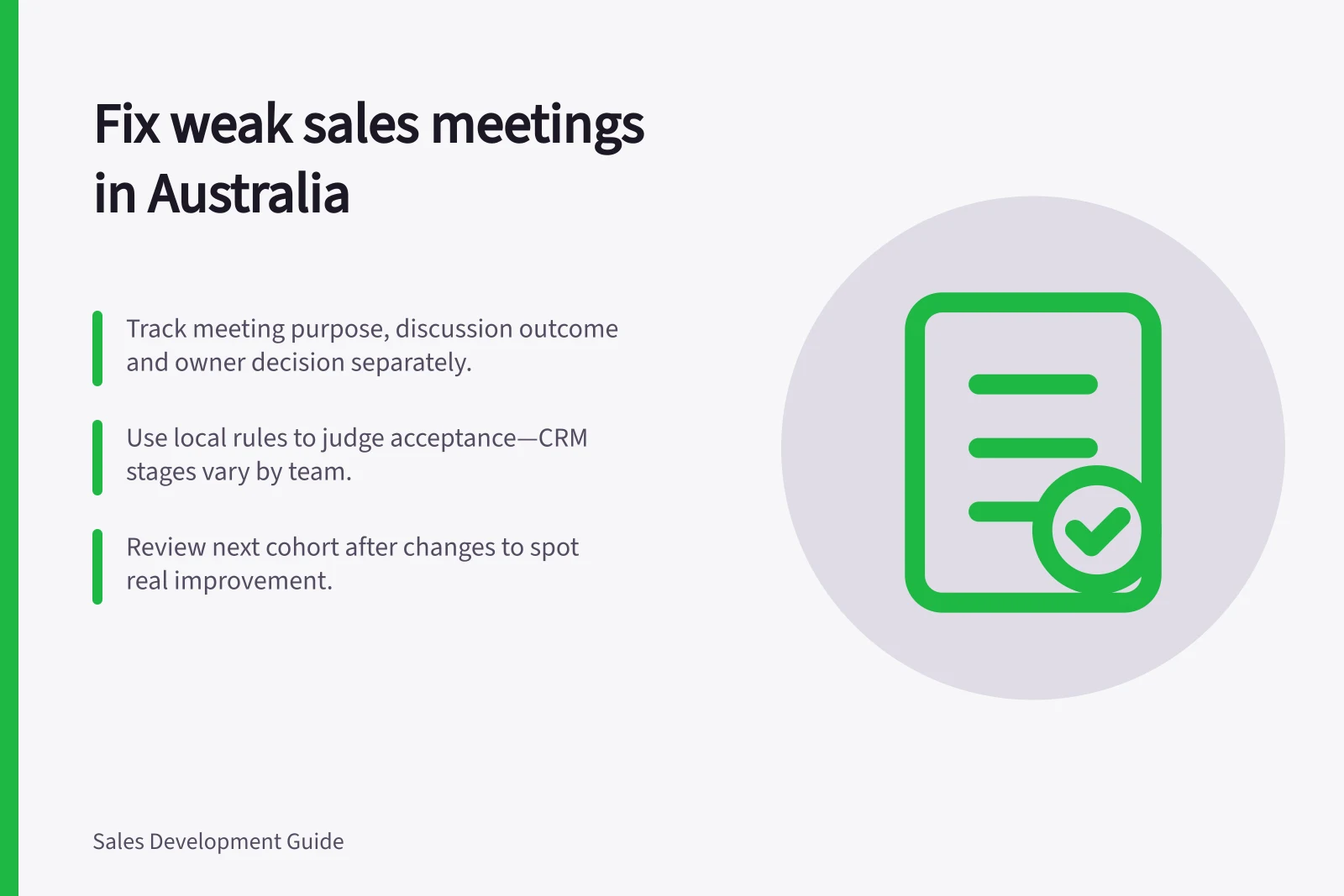
For held meetings, record whether the discussion addressed its stated purpose. Then record the receiving owner’s separate decision to pursue, return, redirect or close the proposed opportunity.
Meeting attendance, qualification under a local rule and receiving-owner acceptance answer different questions. An opportunity record does not necessarily establish acceptance: CRM stages and creation rules vary by team. Use the agreed local decision and retain its reason. Use those records to diagnose a programme gap; detailed metric definitions and a fair individual qualification review have separate roles.
Read both sides of the meeting
Compare what prompted the booking with what the salesperson learned. Look for the prospect’s stated issue or question, a relevant offer condition and the purpose the prospect accepted. Mark whether the original note held a fact, a seller inference or an unknown. Ask the receiving owner why they continued or stopped.
Repeated finding / Programme question
- The prospect expected an answer but received a broad demonstration
- Was the meeting purpose too large for their question?
- A required capability was already known to be absent
- Why did the account pass the fit gate?
- The purpose was sound but the sales owner lacked context
- What was lost before the meeting?
- The prospect changed plans after booking
- Was the original decision reasonable on what was known then?
- Sales owners apply different thresholds
- Which rule should future proposals use?
These findings call for different actions. A later change of plans does not prove the booking was unsound. A sparse record may prevent judgement rather than establish that the meeting was poor.
Meeting Purpose vs. Salesperson's Outcome: Common Disconnects
- Prospect expected an answer but received a broad demonstration
- Meeting purpose too large for the original question
- Required capability already known to be absent
- Account passed fit gate without validation
- Purpose sound but sales owner lacked context
- Critical information lost during handover
- Prospect changed plans after booking
- Original decision may still have been reasonable at the time
- Sales owners apply different thresholds
- Need consistent, dated acceptance rule across teams
Fix the earliest avoidable break
If representatives repeatedly offer meetings before checking a required offer condition, add that focused check before booking. If prospects need only a factual answer, provide it in writing and offer a discussion when a useful question remains.
If the meeting had a sound purpose but context was lost, improve the transfer record. If receiving owners disagree despite seeing the same facts, agree on a dated acceptance rule and review examples together.
Do not require every prospect to supply a full budget or buying timetable to repair one weak-meeting pattern. State which unknowns can be resolved during a useful discussion and which must be settled first. Keep justified closes visible so booking volume does not reward unsuitable meetings.
Pre-Meeting Validation Checklist for Australian Outbound Teams
- Confirm offer condition is met before bookingAvoid booking meetings when key capabilities are unavailable.
- Determine if a written response sufficesOffer a discussion only if a meaningful question remains.
- Improve handover documentationEnsure context, intent, and known constraints are retained.
- Define which unknowns can be resolved in discussionClarify what must be settled before the meeting.
- Keep justified closes visiblePrevent rewarding unsuitable meetings via volume alone.
Review the next cohort
Record the change, its effective date and the bookings it covers. Follow a later booking cohort long enough for meetings and receiving-owner decisions to occur.
Report pending cases alongside accepted and returned proposals. Read the notes as well as the ratios: an apparent improvement may reflect a narrower account mix, a different receiving owner or a changed definition.
Before any revised outreach, review the Australian Communications and Media Authority’s guidance on avoiding spam.
Key Metrics to Monitor After Process Changes
- Meetings Held
- Number of confirmed meetings post-change
- Meetings Cancelled/Missed
- Rate of non-attendance or rescheduling
- Opportunities Pursued
- Proposals accepted by receiving owners
- Opportunities Returned/Redirected
- Cases declined or reassigned
- Pending Cases
- Open opportunities awaiting decision