Deliverability
Part of Outbound follow-up sequences
Recording opt-outs across sales systems
Capture opt-outs once, propagate them across all sales systems and verify that queued messages cannot re-contact the person.
Treat an opt-out as a change to a central customer profile, then carry that state into the CRM, sequencing tool, email platform and any agency or separate team that can send on the business’s behalf. Each sending system should check the updated state before sending.
For commercial email and SMS, the Spam Act 2003 (Cth) requires a clear, functional unsubscribe facility, and requests must be processed within five business days. ACMA enforces the spam rules; telephone marketing has a separate Do Not Call Register framework.
Record the request at the source
When a request arrives, record the contact identifier, channel, time, wording and system that received it. Update the central customer profile as the single source of truth, using consistent values for marketing versus servicing, channel-level opt-outs, product or topic preferences, and do-not-contact flags.
Keep the recorded preference faithful to the request: an email unsubscribe should not automatically become a block on unrelated channels, while a request to stop all marketing should be represented across them. If identity is uncertain, pause sends while the record is resolved.
The Spam Act 2003 (Cth) covers commercial email and SMS; action an unsubscribe within five business days. Keep telephone marketing requests distinct from email and SMS requests, and check the Do Not Call Register under the Do Not Call Register Act 2006.
Where the request record contains personal information, handle it in line with applicable Privacy Act 1988 obligations and the Australian Privacy Principles. The OAIC provides guidance for businesses on privacy obligations.
Opt-out Handling Across Channels
- Channel
- Email / SMS
- Processing Time
- Within 5 business days
- Action Required
- Functional unsubscribe facility with clear instructions
- Channel
- Telephone marketing
- Processing Time
- Immediate check against register
- Action Required
- Verify number on Do Not Call Register before calling
Compliance Requirements Summary
- Unsubscribe Processing Time
- 5 business days
- Enforcement Body
- ACMA
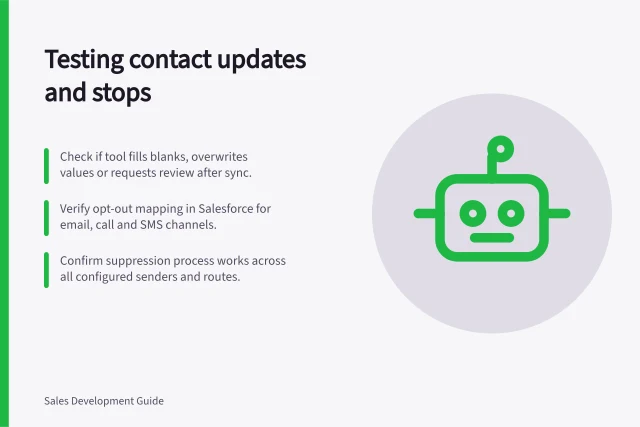
Test the propagation
Connect the central profile to the CRM, sequencing tool and email platform so each uses the same preference state. Push changes through APIs and suppression lists in near real time, and configure every sending system to check the central record before sending.
When the state changes, remove pending sequence steps and update downstream suppression lists. Track systems that rely on nightly batches and any manual workarounds, so delays or gaps are visible.
Test each opt-out entry point used by the business, such as an email unsubscribe, SMS reply or web form. For each test, check that the central profile records the request and that the sequencing tool blocks pending steps and the email platform suppresses the address; pass only when every relevant system reflects the request.
Check duplicate records and alternate addresses against the same unified customer profile or household, and test records owned by another team. Link only identifiers established as belonging to the same person, avoid blocking unrelated contacts, and pause sends if identity remains uncertain.
Log when and how the opt-out was captured, where it was applied, and which campaigns were suppressed. Keep the evidence needed to show the request was honoured, limit access to those who need it, and give later users a clear do-not-contact-for-marketing state rather than a blank activity history.